2. a student council is holding a fundraiser. students can spin the spinner shown twice and receive a…
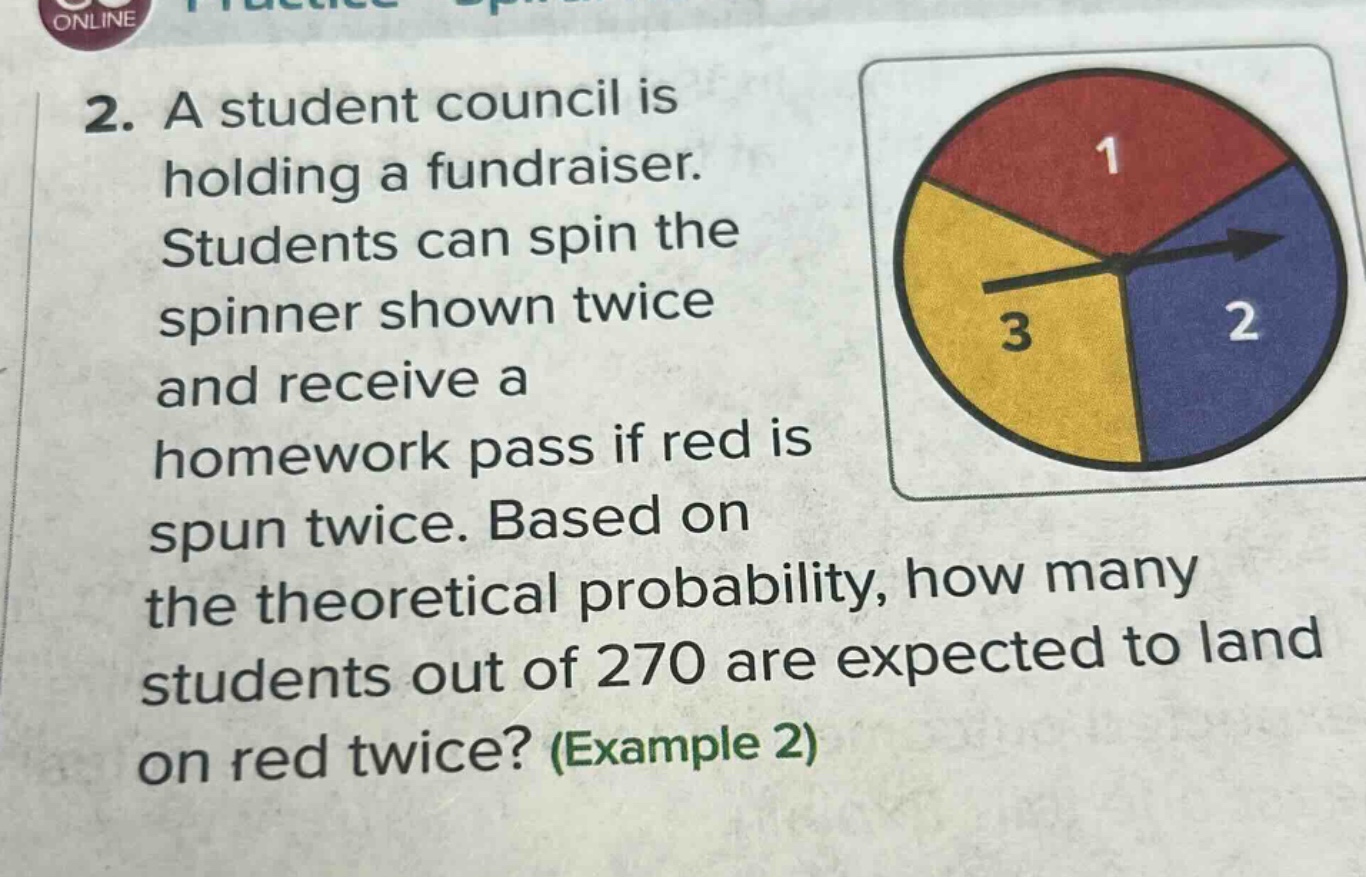
2. a student council is holding a fundraiser. students can spin the spinner shown twice and receive a homework pass if red is spun twice. based on the theoretical probability, how many students out of 270 are expected to land on red twice? (example 2)
Answer
Explanation:
Step1: Calculate the probability of spinning red once
The spinner is divided into 3 equal - sized sections. The probability of spinning red (section 1) in a single spin is $P(\text{red})=\frac{1}{3}$.
Step2: Calculate the probability of spinning red twice
Since the two spins are independent events, the probability of two independent events $A$ and $B$ both occurring is $P(A\cap B)=P(A)\times P(B)$. Here, $A$ and $B$ are the events of spinning red in the first and second spins respectively. So $P(\text{red twice})=\frac{1}{3}\times\frac{1}{3}=\frac{1}{9}$.
Step3: Calculate the expected number of students
We use the formula $E = n\times P$, where $n = 270$ (the total number of students) and $P=\frac{1}{9}$ (the probability of spinning red twice). So $E=270\times\frac{1}{9}=30$.
Answer:
30