each student in ms. taylors class has two standard number cubes. each student records the number of rolls it…
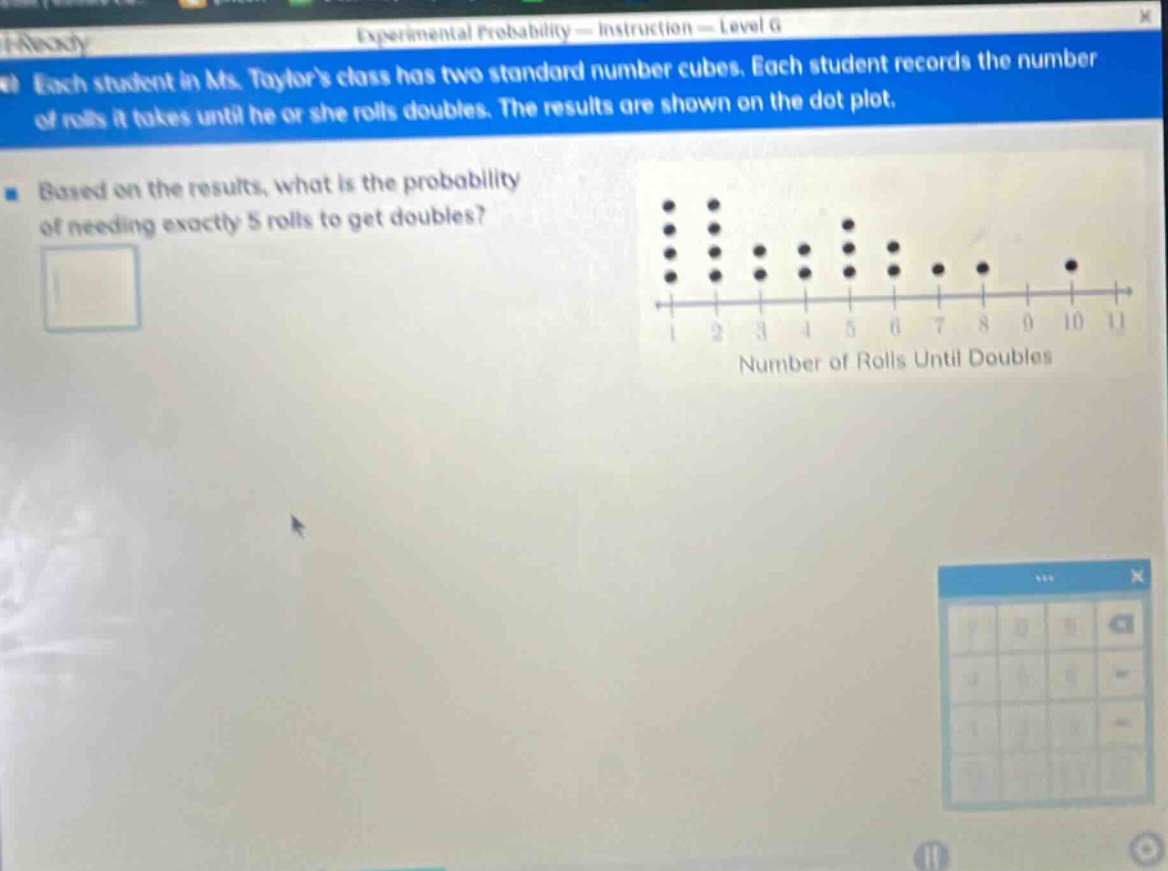
each student in ms. taylors class has two standard number cubes. each student records the number of rolls it takes until he or she rolls doubles. the results are shown on the dot - plot. based on the results, what is the probability of needing exactly 5 rolls to get doubles?
Answer
Explanation:
Step1: Count total number of data - points
Count all the dots on the dot - plot. There are 6 + 5+ 3+ 3+ 4+ 3+ 1+ 1+ 1 = 27 dots.
Step2: Count number of data - points for 5 rolls
Count the number of dots above the number 5 on the horizontal axis. There are 4 dots above 5.
Step3: Calculate probability
The probability $P$ of an event is given by the formula $P=\frac{\text{Number of favorable outcomes}}{\text{Total number of outcomes}}$. Here, the number of favorable outcomes (rolling doubles in exactly 5 rolls) is 4, and the total number of outcomes is 27. So $P = \frac{4}{27}$.
Answer:
$\frac{4}{27}$