students in mrs. barness class determined the probability that she will check homework on a randomly chosen…
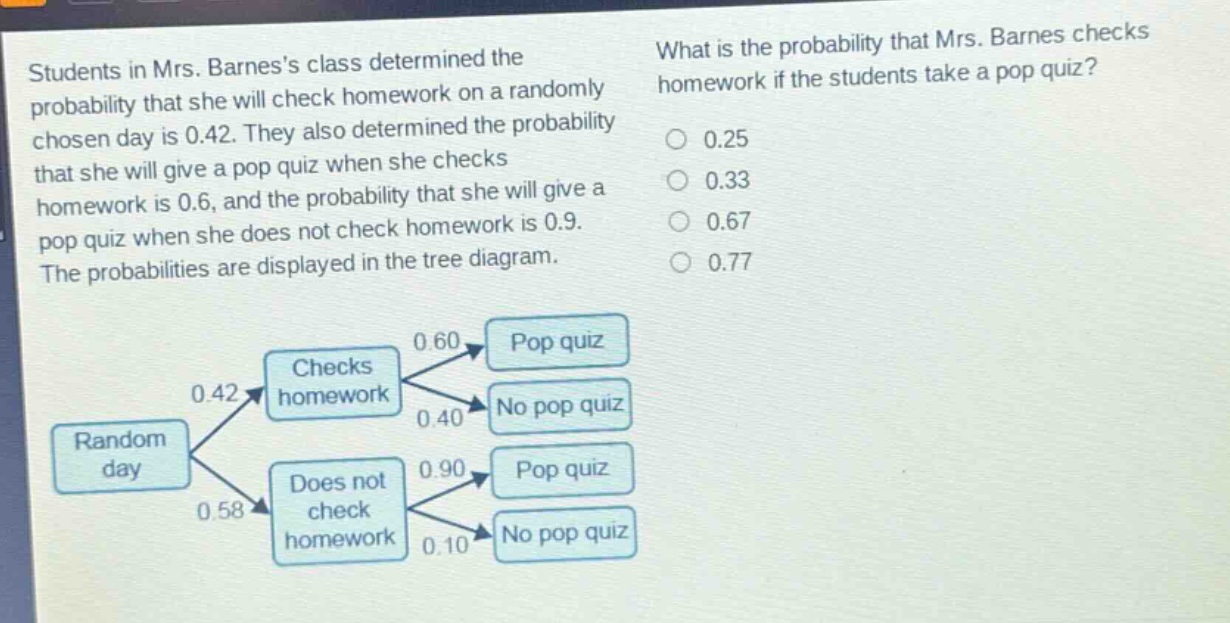
students in mrs. barness class determined the probability that she will check homework on a randomly chosen day is 0.42. they also determined the probability that she will give a pop quiz when she checks homework is 0.6, and the probability that she will give a pop quiz when she does not check homework is 0.9. the probabilities are displayed in the tree diagram. what is the probability that mrs. barnes checks homework if the students take a pop quiz? 0.25 0.33 0.67 0.77
Answer
Explanation:
Step1: Use Bayes' theorem formula
Let $A$ be the event that she checks homework and $B$ be the event that there is a pop - quiz. We want to find $P(A|B)$. By Bayes' theorem, $P(A|B)=\frac{P(B|A)P(A)}{P(B)}$. First, find $P(B)$.
Step2: Calculate $P(B)$
$P(B)$ is the total probability of a pop - quiz. Using the law of total probability, $P(B)=P(B|A)P(A)+P(B|\overline{A})P(\overline{A})$. Here, $P(A) = 0.42$, $P(B|A)=0.6$, $P(\overline{A})=1 - 0.42=0.58$, and $P(B|\overline{A}) = 0.9$. So $P(B)=(0.6\times0.42)+(0.9\times0.58)=0.252 + 0.522=0.774$.
Step3: Calculate $P(A|B)$
We know $P(B|A) = 0.6$ and $P(A)=0.42$. Then $P(A|B)=\frac{P(B|A)P(A)}{P(B)}=\frac{0.6\times0.42}{0.774}=\frac{0.252}{0.774}\approx0.33$.
Answer:
0.33