students in a science class roll a model car down a ramp. they repeat this process for 5 trials, recording…
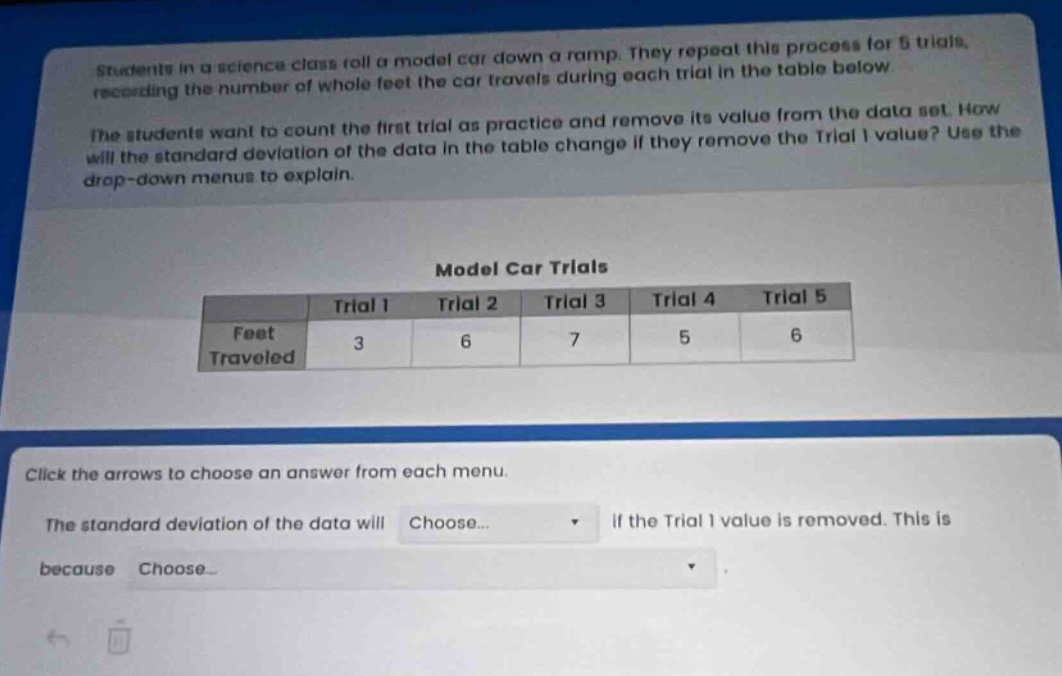
students in a science class roll a model car down a ramp. they repeat this process for 5 trials, recording the number of whole feet the car travels during each trial in the table below.\nthe students want to count the first trial as practice and remove its value from the data set. how will the standard deviation of the data in the table change if they remove the trial 1 value? use the drop - down menus to explain.\n\nmodel car trials\n| |trial 1|trial 2|trial 3|trial 4|trial 5|\n|--|--|--|--|--|--|\n|feet traveled|3|6|7|5|6|\n\nclick the arrows to choose an answer from each menu.\nthe standard deviation of the data will choose... if the trial 1 value is removed. this is because choose...
Answer
Explanation:
Step1: Calculate the mean of the original data set
The original data set is (3,6,7,5,6). The mean (\bar{x}_1=\frac{3 + 6+7+5+6}{5}=\frac{27}{5} = 5.4).
Step2: Calculate the standard - deviation of the original data set
The squared differences from the mean are ((3 - 5.4)^2=(-2.4)^2 = 5.76), ((6 - 5.4)^2=(0.6)^2 = 0.36), ((7 - 5.4)^2=(1.6)^2 = 2.56), ((5 - 5.4)^2=(-0.4)^2 = 0.16), ((6 - 5.4)^2=(0.6)^2 = 0.36). The variance (s_1^2=\frac{5.76+0.36 + 2.56+0.16+0.36}{5}=\frac{9.2}{5}=1.84), and the standard - deviation (s_1=\sqrt{1.84}\approx1.36).
Step3: Calculate the mean of the new data set (after removing Trial 1)
The new data set is (6,7,5,6). The mean (\bar{x}_2=\frac{6 + 7+5+6}{4}=\frac{24}{4}=6).
Step4: Calculate the standard - deviation of the new data set
The squared differences from the mean are ((6 - 6)^2 = 0), ((7 - 6)^2=1), ((5 - 6)^2 = 1), ((6 - 6)^2 = 0). The variance (s_2^2=\frac{0 + 1+1+0}{4}=\frac{2}{4}=0.5), and the standard - deviation (s_2=\sqrt{0.5}\approx0.71).
Answer:
The standard deviation of the data will decrease. This is because the value of 3 in Trial 1 is an out - lier relative to the other values, and removing it makes the data more clustered around the mean.