a study looked at the prices that several grocery stores charged for the same 15 - ounce can of tomato…
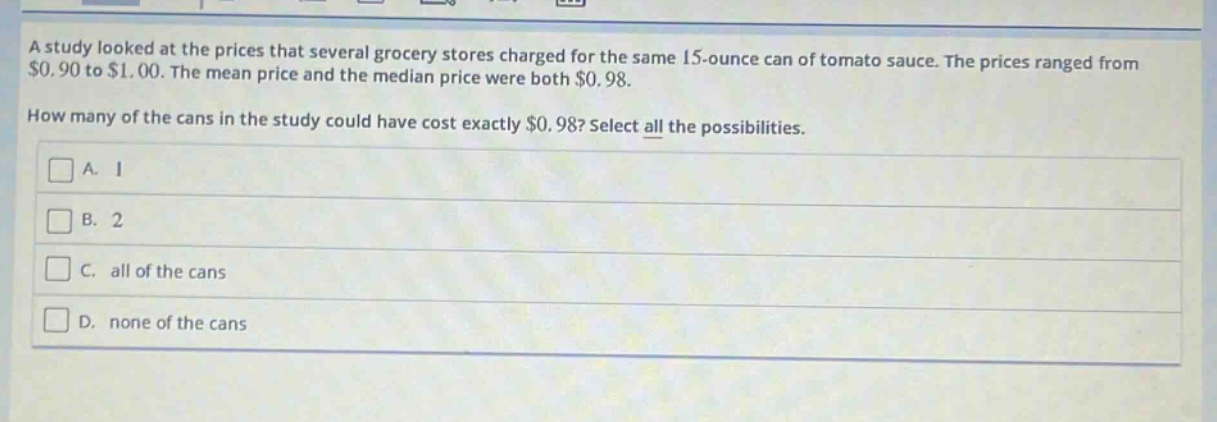
a study looked at the prices that several grocery stores charged for the same 15 - ounce can of tomato sauce. the prices ranged from $0.90 to $1.00. the mean price and the median price were both $0.98. how many of the cans in the study could have cost exactly $0.98? select all the possibilities. a. 1 b. 2 c. all of the cans d. none of the cans
Answer
Answer:
A. 1, B. 2, C. all of the cans, D. none of the cans
Explanation:
Step1: Understand mean and median
Mean is sum of values divided by number of values. Median is middle - value when data is ordered.
Step2: Analyze option A
One can with price $0.98$ is possible as it won't necessarily affect mean and median values.
Step3: Analyze option B
Two cans with price $0.98$ is also possible as they can be part of data set without changing mean and median.
Step4: Analyze option C
If all cans cost $0.98$, mean and median will both be $0.98$.
Step5: Analyze option D
It's possible to have a data - set where mean and median are $0.98$ without any can costing exactly $0.98$. For example, some values above and some below $0.98$ can balance out to give mean and median of $0.98$.