subjects taught\n| | english | not english | total |\n|--|--|--|--|\n| math | 34 | 22 | 56 |\n| not math |…
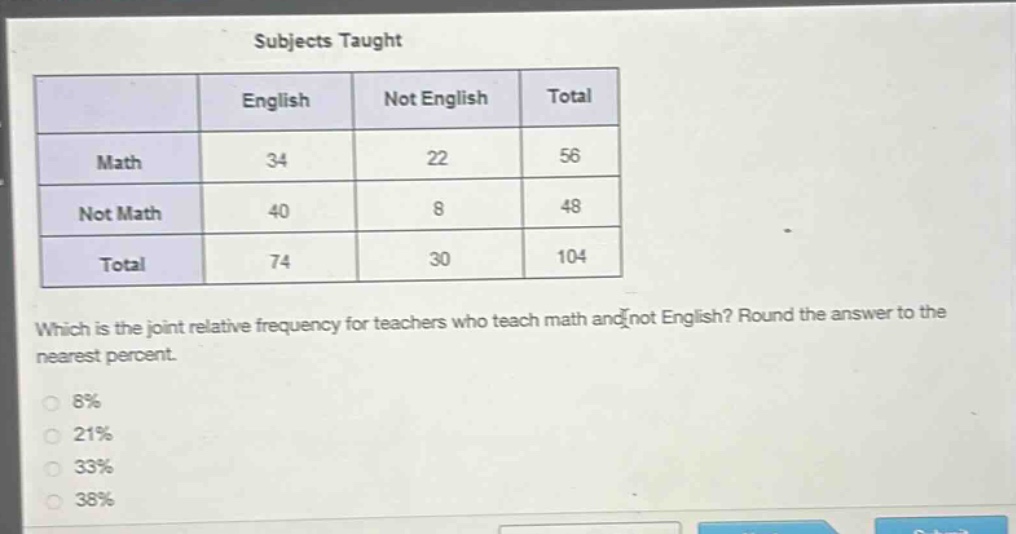
subjects taught\n| | english | not english | total |\n|--|--|--|--|\n| math | 34 | 22 | 56 |\n| not math | 40 | 8 | 48 |\n| total | 74 | 30 | 104 |\nwhich is the joint relative frequency for teachers who teach math and not english? round the answer to the nearest percent.\n8%\n21%\n33%\n38%
Answer
Explanation:
Step1: Recall joint - relative frequency formula
Joint relative frequency = $\frac{\text{Frequency of the cell}}{\text{Total frequency}}$
Step2: Identify relevant frequencies
The frequency of teachers who teach math and not English is 22, and the total frequency is 104.
Step3: Calculate joint - relative frequency
Joint relative frequency = $\frac{22}{104}\approx 0.2115$
Step4: Convert to percentage
$0.2115\times100% = 21.15%$. Rounding to the nearest percent gives 21%.
Answer:
21%