summer plans\n| | camp | no camp | total |\n|--|--|--|--|\n| swimming lessons | 42 | 32 | 74 |\n| no…
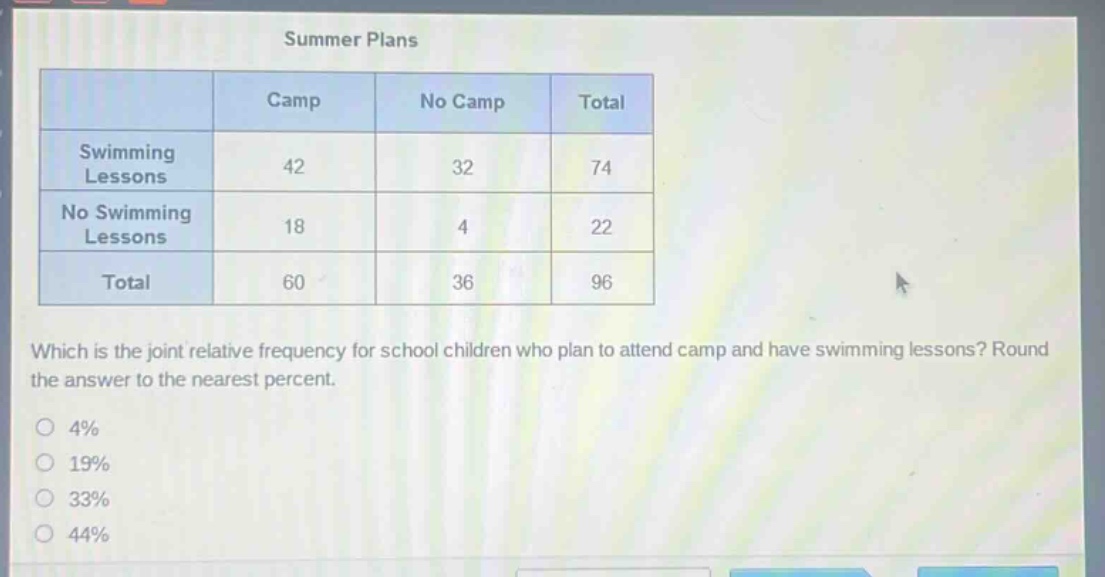
summer plans\n| | camp | no camp | total |\n|--|--|--|--|\n| swimming lessons | 42 | 32 | 74 |\n| no swimming lessons | 18 | 4 | 22 |\n| total | 60 | 36 | 96 |\nwhich is the joint relative frequency for school children who plan to attend camp and have swimming lessons? round the answer to the nearest percent.\n4%\n19%\n33%\n44%
Answer
Explanation:
Step1: Recall joint - relative frequency formula
Joint relative frequency = $\frac{\text{Frequency of the joint event}}{\text{Total number of data points}}$
Step2: Identify the frequency of the joint event and total number of data points
The frequency of school children who plan to attend camp and have swimming lessons is 42. The total number of school children is 96.
Step3: Calculate the joint - relative frequency
Joint relative frequency = $\frac{42}{96}= 0.4375$
Step4: Convert to percentage and round
$0.4375\times100% = 43.75%$, rounded to the nearest percent is 44%
Answer:
44%