(1) suppose you are advising the police department about police patrol assignment. one neighborhood had a…
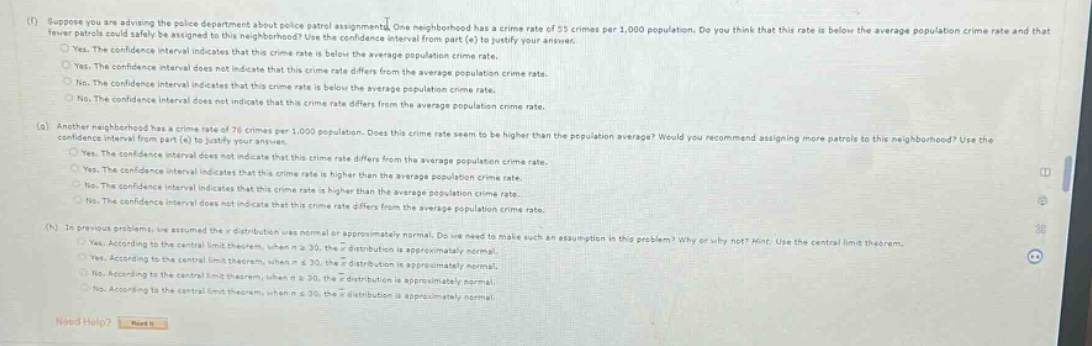
(1) suppose you are advising the police department about police patrol assignment. one neighborhood had a crime rate of 55 crimes per 1,000 population. do you think that this rate is below the average population crime rate and that fewer patrols could safely be assigned to this neighborhood? use the confidence interval from part (e) to justify your answer. \nyes. the confidence interval indicates that this crime rate is below the average population crime rate. \nyes. the confidence interval does not indicate that this crime rate differs from the average population crime rate. \nno. the confidence interval indicates that this crime rate is below the average population crime rate. \nno. the confidence interval does not indicate that this crime rate differs from the average population crime rate. \n(a) another neighborhood had a crime rate of 76 crimes per 1,000 population. does this crime rate seem to be higher than the population average? would you recommend assigning more patrols to this neighborhood? use the confidence interval from part (e) to justify your answer. \nyes. the confidence interval does not indicate that this crime rate differs from the average population crime rate. \nyes. the confidence interval indicates that this crime rate is higher than the average population crime rate. \nno. the confidence interval indicates that this crime rate is higher than the average population crime rate. \nno. the confidence interval does not indicate that this crime rate differs from the average population crime rate. \n(n) in previous problems, we assumed the x - distribution was normal or approximately normal. do we need to make such an assumption in this problem? why or why not? hint: use the central limit theorem. \nyes. according to the central limit theorem, when n≥30, the x - distribution is approximately normal. \nyes. according to the central limit theorem, when n <30, the x - distribution is approximately normal. \nno. according to the central limit theorem, when n≥30, the x - distribution is approximately normal. \nno. according to the central limit theorem, when n <30, the x - distribution is approximately normal.
Answer
Explanation:
Step1: Analyze first - part question
We need to determine if a crime rate of 55 crimes per 1000 population is below the average based on a confidence interval (not given in the problem - but we assume we would check if the value is below the lower - bound of the confidence interval for the average population crime rate). If the value is below the lower - bound of the confidence interval for the average, then the answer is yes, the rate is below the average. If it's not, the answer is no.
Step2: Analyze second - part question
For a crime rate of 76 crimes per 1000 population, we check if it's above the upper - bound of the confidence interval for the average population crime rate. If it is, we recommend more patrols as the rate is higher than average.
Step3: Analyze third - part question
According to the central limit theorem, when the sample size (n\geq30), the sampling distribution of the sample mean (\bar{x}) is approximately normal regardless of the shape of the population distribution. So, if we have a sample size of at least 30, we do not need to assume the population is normal.
Answer:
- Without the confidence interval from part (e), we cannot determine the answer. But conceptually, if the 55 crimes per 1000 is below the lower - bound of the confidence interval for the average population crime rate, the answer is "Yes. The confidence interval indicates that this crime rate is below the average population crime rate."; otherwise, "No. The confidence interval indicates that this crime rate is not below the average population crime rate."
- Without the confidence interval from part (e), we cannot determine the answer. But conceptually, if the 76 crimes per 1000 is above the upper - bound of the confidence interval for the average population crime rate, the answer is "Yes. The confidence interval indicates that this crime rate is higher than the average population crime rate."; otherwise, "No. The confidence interval indicates that this crime rate is not higher than the average population crime rate."
- No. According to the central limit theorem, when (n\geq30), the (\bar{x}) distribution is approximately normal.