a survey was conducted at a high school to study which instruments students are interested in learning. the…
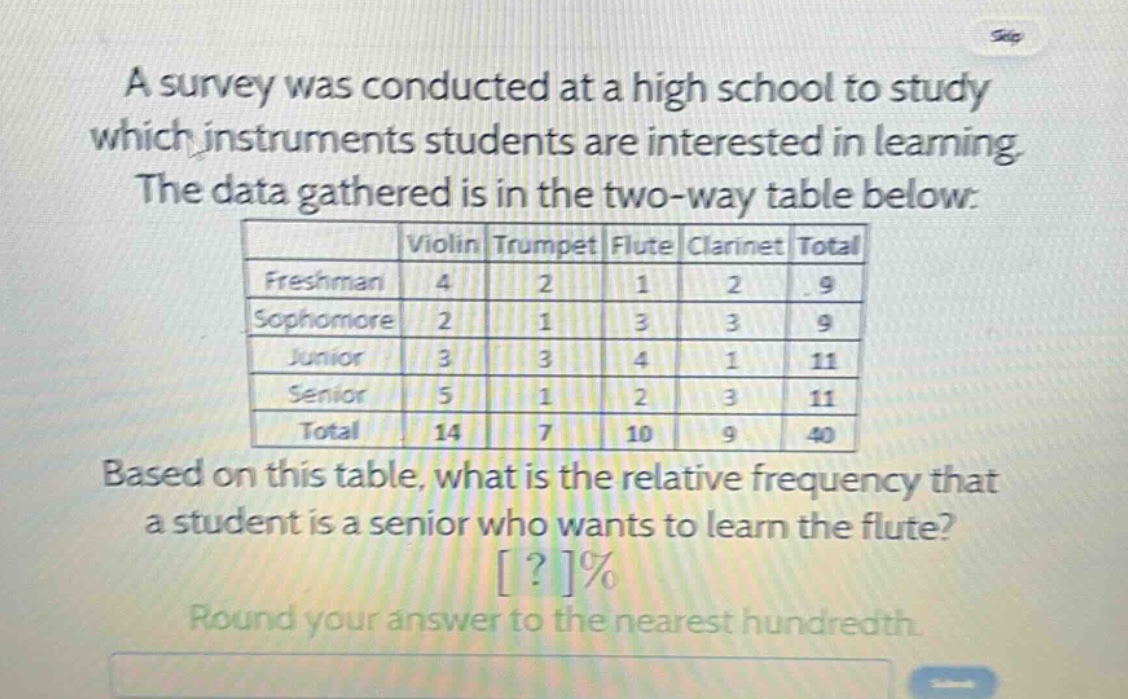
a survey was conducted at a high school to study which instruments students are interested in learning. the data gathered is in the two - way table below:\n| |violin|trumpet|flute|clarinet|total|\n|----|----|----|----|----|----|\n|freshman|4|2|1|2|9|\n|sophomore|2|1|3|3|9|\n|junior|3|3|4|1|11|\n|senior|5|1|2|3|11|\n|total|14|7|10|9|40|\nbased on this table, what is the relative frequency that a student is a senior who wants to learn the flute? ?% \nround your answer to the nearest hundredth.
Answer
Explanation:
Step1: Identify relevant values
The number of seniors who want to learn the flute is 2, and the total number of students is 40.
Step2: Calculate relative - frequency
The relative - frequency formula is $\text{Relative Frequency}=\frac{\text{Number of favorable outcomes}}{\text{Total number of outcomes}}$. So, $\text{Relative Frequency}=\frac{2}{40}$.
Step3: Convert to percentage
$\frac{2}{40}=0.05$, and to convert to a percentage, we multiply by 100. So, $0.05\times100 = 5%$.
Answer:
5%