a survey finds that 48% of people identify themselves as fans of professional football, 12% as fans of car…
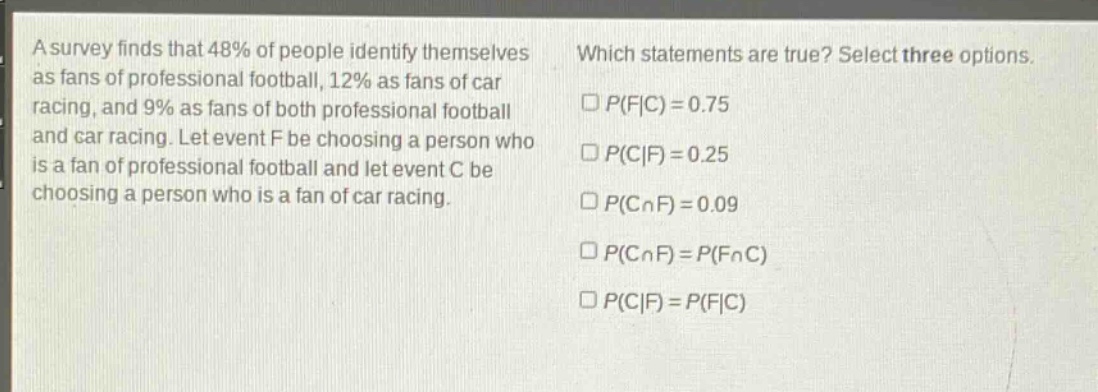
a survey finds that 48% of people identify themselves as fans of professional football, 12% as fans of car racing, and 9% as fans of both professional football and car racing. let event f be choosing a person who is a fan of professional football and let event c be choosing a person who is a fan of car racing. which statements are true? select three options. □p(f|c)=0.75 □p(c|f)=0.25 □p(c∩f)=0.09 □p(c∩f)=p(f∩c) □p(c|f)=p(f|c)
Answer
Answer:
C. $P(C\cap F)=0.09$, D. $P(C\cap F)=P(F\cap C)$, A. $P(F|C) = 0.75$
Explanation:
Step1: Recall probability - intersection formula
The probability of the intersection of two events $A$ and $B$ is the probability that both $A$ and $B$ occur. Given that 9% of people are fans of both professional football and car - racing, so $P(C\cap F)=0.09$. Also, by the commutative property of intersection, $P(C\cap F)=P(F\cap C)$.
Step2: Use conditional - probability formula
The formula for conditional probability is $P(A|B)=\frac{P(A\cap B)}{P(B)}$. We know that $P(F) = 0.48$, $P(C)=0.12$ and $P(C\cap F)=0.09$. Then $P(F|C)=\frac{P(F\cap C)}{P(C)}=\frac{0.09}{0.12}=0.75$.
Step3: Check $P(C|F)$
$P(C|F)=\frac{P(C\cap F)}{P(F)}=\frac{0.09}{0.48}= 0.1875\neq0.25$ and $P(C|F)\neq P(F|C)$ since $P(C|F)=\frac{P(C\cap F)}{P(F)}$ and $P(F|C)=\frac{P(F\cap C)}{P(C)}$ and $P(F)\neq P(C)$.