a survey showed that 35% of human resource professionals are at companies that rejected job candidates…
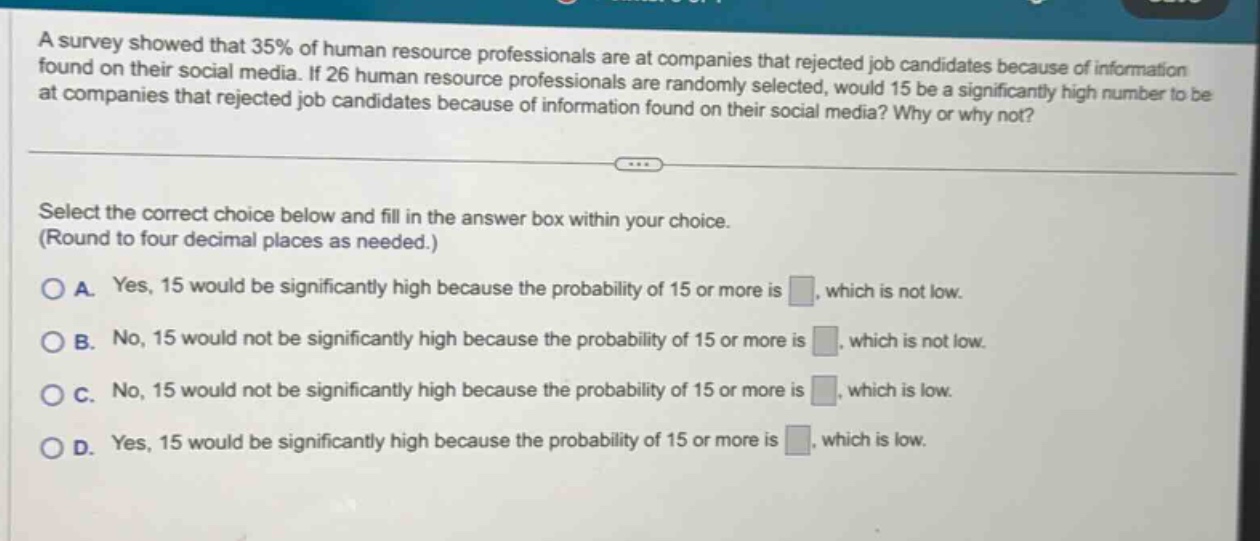
a survey showed that 35% of human resource professionals are at companies that rejected job candidates because of information found on their social media. if 26 human resource professionals are randomly selected, would 15 be a significantly high number to be at companies that rejected job candidates because of information found on their social media? why or why not? select the correct choice below and fill in the answer box within your choice. (round to four decimal places as needed.) a. yes, 15 would be significantly high because the probability of 15 or more is . which is not low. b. no, 15 would not be significantly high because the probability of 15 or more is . which is not low. c. no, 15 would not be significantly high because the probability of 15 or more is . which is low. d. yes, 15 would be significantly high because the probability of 15 or more is . which is low.
Answer
Explanation:
Step1: Identify binomial parameters
Let (n = 26) (number of trials, i.e., number of selected human - resource professionals), (p=0.35) (probability of a human - resource professional being at a company that rejected job candidates due to social - media information).
Step2: Use the binomial probability formula
The binomial probability formula is (P(X = k)=C(n,k)\times p^{k}\times(1 - p)^{n - k}), where (C(n,k)=\frac{n!}{k!(n - k)!}). We want to find (P(X\geq15)=\sum_{k = 15}^{26}P(X = k)=\sum_{k = 15}^{26}C(26,k)\times(0.35)^{k}\times(0.65)^{26 - k}). We can also use a normal approximation to the binomial distribution. The mean of the binomial distribution is (\mu=np=26\times0.35 = 9.1), and the standard deviation is (\sigma=\sqrt{np(1 - p)}=\sqrt{26\times0.35\times(1 - 0.35)}=\sqrt{9.1\times0.65}=\sqrt{5.915}\approx2.432). Using the normal - approximation with continuity correction, we want to find (P(X\geq15)) for the binomial, which is equivalent to (P(X>14.5)) for the normal distribution. We calculate the z - score: (z=\frac{x-\mu}{\sigma}=\frac{14.5 - 9.1}{2.432}=\frac{5.4}{2.432}\approx2.22). (P(Z>2.22)=1 - P(Z\leq2.22)). From the standard normal table, (P(Z\leq2.22) = 0.9868), so (P(Z>2.22)=1 - 0.9868 = 0.0132).
Answer:
D. Yes, 15 would be significantly high because the probability of 15 or more is (0.0132), which is low.