a survey was taken of children between the ages of 7 and 12. let a be the event that the person rides the…
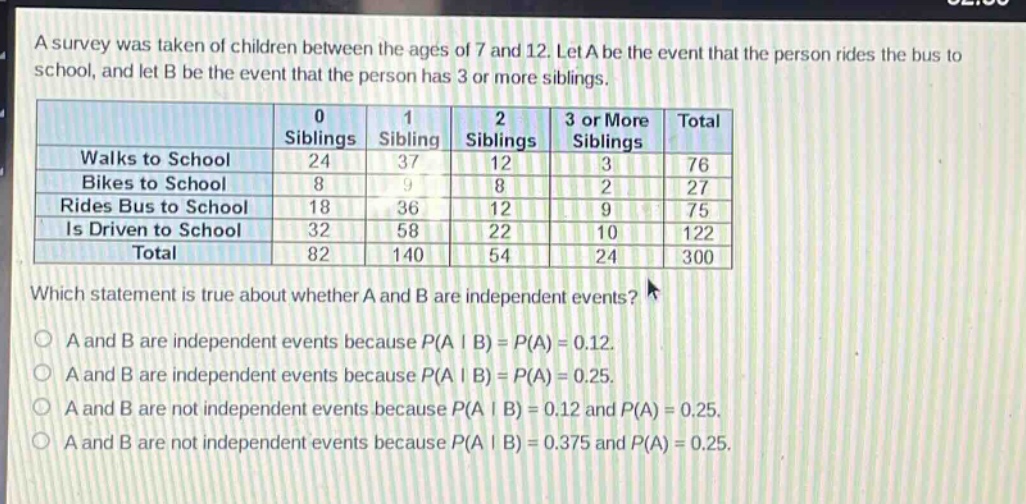
a survey was taken of children between the ages of 7 and 12. let a be the event that the person rides the bus to school, and let b be the event that the person has 3 or more siblings.\n| |0 siblings|1 sibling|2 siblings|3 or more siblings|total|\n|--|--|--|--|--|--|\n|walks to school|24|37|12|3|76|\n|bikes to school|8|9|8|2|27|\n|rides bus to school|18|36|12|9|75|\n|is driven to school|32|58|22|10|122|\n|total|82|140|54|24|300|\nwhich statement is true about whether a and b are independent events?\na and b are independent events because p(a | b)=p(a)=0.12.\na and b are independent events because p(a | b)=p(a)=0.25.\na and b are not independent events because p(a | b)=0.12 and p(a)=0.25.\na and b are not independent events because p(a | b)=0.375 and p(a)=0.25.
Answer
Explanation:
Step1: Calculate (P(A))
The number of students who ride the bus to school (n(A)=75), and the total number of students (n = 300). So (P(A)=\frac{n(A)}{n}=\frac{75}{300}=0.25).
Step2: Calculate (P(A|B))
The number of students with 3 or more siblings (n(B)=24), and the number of students with 3 or more siblings who ride the bus (n(A\cap B)=9). Then (P(A|B)=\frac{n(A\cap B)}{n(B)}=\frac{9}{24}=0.375).
Step3: Check for independence
Two events (A) and (B) are independent if (P(A|B)=P(A)). Since (P(A|B) = 0.375) and (P(A)=0.25), (P(A|B)\neq P(A)), so (A) and (B) are not - independent events.
Answer:
A and B are not independent events because (P(A|B)=0.375) and (P(A)=0.25).