a survey of teens suggested that 33% can name at least one professional baseball player, and 90% of those…
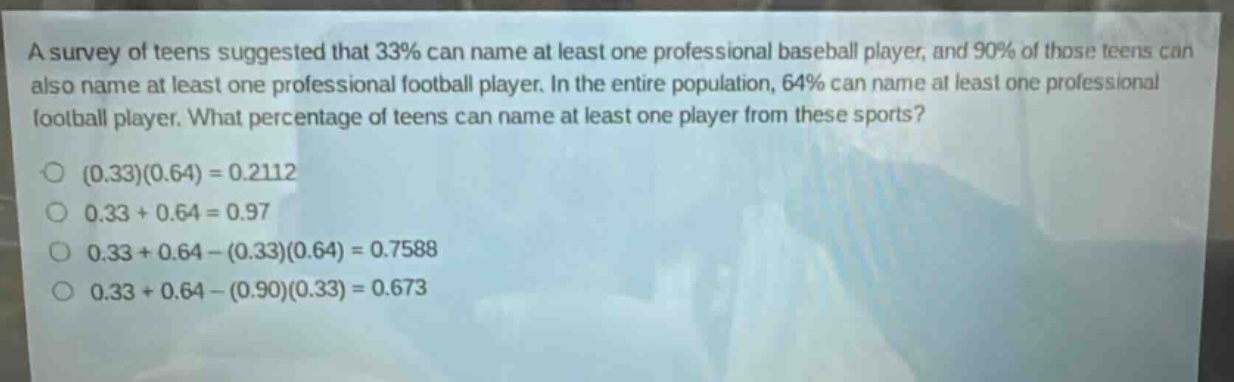
a survey of teens suggested that 33% can name at least one professional baseball player, and 90% of those teens can also name at least one professional football player. in the entire population, 64% can name at least one professional football player. what percentage of teens can name at least one player from these sports?\n(0.33)(0.64)=0.2112\n0.33 + 0.64 = 0.97\n0.33 + 0.64-(0.33)(0.64)=0.7588\n0.33 + 0.64-(0.90)(0.33)=0.673
Answer
Explanation:
Step1: Define the sets
Let $A$ be the set of teens who can name a baseball - player ($P(A)=0.33$), and $B$ be the set of teens who can name a football - player ($P(B)=0.64$). The probability that a teen who can name a baseball player can also name a football player is $P(B|A) = 0.9$. By the formula $P(A\cap B)=P(B|A)P(A)$, we have $P(A\cap B)=(0.9)(0.33)$.
Step2: Use the inclusion - exclusion principle
The inclusion - exclusion principle for two events is $P(A\cup B)=P(A)+P(B)-P(A\cap B)$. Substitute $P(A) = 0.33$, $P(B)=0.64$, and $P(A\cap B)=(0.9)(0.33)$ into the formula. $P(A\cup B)=0.33 + 0.64-(0.9)(0.33)$. $P(A\cup B)=0.33+0.64 - 0.297=0.673$.
Answer:
$0.33 + 0.64-(0.90)(0.33)=0.673$