table b: frequency of foreign - language studies by row\ntable b: frequency of foreign - language studies by…
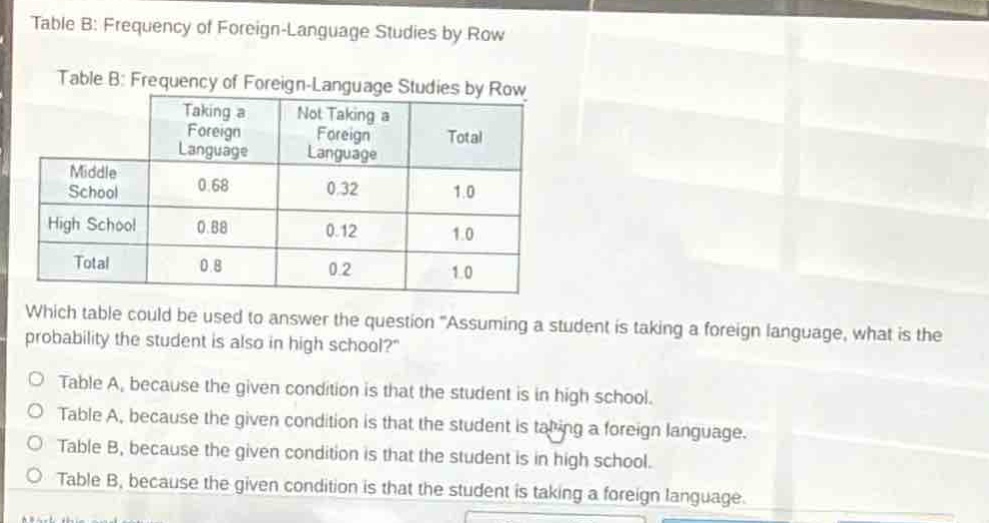
table b: frequency of foreign - language studies by row\ntable b: frequency of foreign - language studies by row\n| |taking a foreign language|not taking a foreign language|total|\n|--|--|--|--|\n|middle school|0.68|0.32|1.0|\n|high school|0.88|0.12|1.0|\n|total|0.8|0.2|1.0|\nwhich table could be used to answer the question “assuming a student is taking a foreign language, what is the probability the student is also in high school?”\ntable a, because the given condition is that the student is in high school.\ntable a, because the given condition is that the student is taking a foreign language.\ntable b, because the given condition is that the student is in high school.\ntable b, because the given condition is that the student is taking a foreign language.
Answer
Explanation:
Step1: Recall conditional - probability concept
We want to find $P(\text{High School}|\text{Taking a Foreign Language})$. In conditional probability, we need to use the information where the condition (taking a foreign - language) is the given part.
Step2: Analyze the tables
Table B has rows representing the level of school (Middle School and High School) and columns representing taking or not taking a foreign language. To find the probability of a student being in high school given they are taking a foreign language, we need to use the information where the condition of taking a foreign language is already accounted for. Table B has the frequencies set up in a way that we can calculate the required conditional probability as it has the "Taking a Foreign Language" and "Not Taking a Foreign Language" columns.
Answer:
Table B, because the given condition is that the student is taking a foreign language.