the table below gives the probability density for a particular bowl of candy.\ncolor brown red orange yellow…
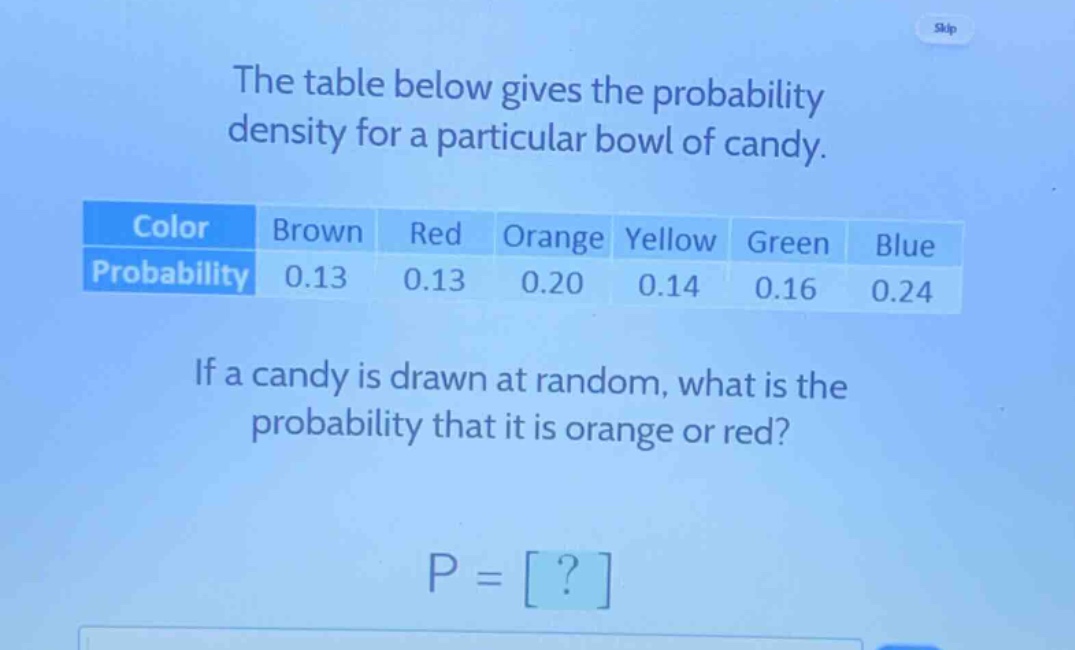
the table below gives the probability density for a particular bowl of candy.\ncolor brown red orange yellow green blue\nprobability 0.13 0.13 0.20 0.14 0.16 0.24\nif a candy is drawn at random, what is the probability that it is orange or red?\np = ?
Answer
Answer:
0.33
Explanation:
Step1: Identify relevant probabilities
Let $P(\text{Orange}) = 0.20$ and $P(\text{Red})=0.13$.
Step2: Use addition - rule for mutually - exclusive events
Since drawing an orange candy and a red candy are mutually - exclusive events (a candy can't be both orange and red at the same time), the formula for $P(A\cup B)$ (probability of $A$ or $B$) is $P(A\cup B)=P(A)+P(B)$. Here $A$ is the event of drawing an orange candy and $B$ is the event of drawing a red candy. So $P(\text{Orange}\cup\text{Red})=P(\text{Orange}) + P(\text{Red})$.
Step3: Calculate the result
$P(\text{Orange}\cup\text{Red})=0.20 + 0.13=0.33$.