the table below gives the probability density of trees in a particular park.\n| tree | birch | elm | oak |…
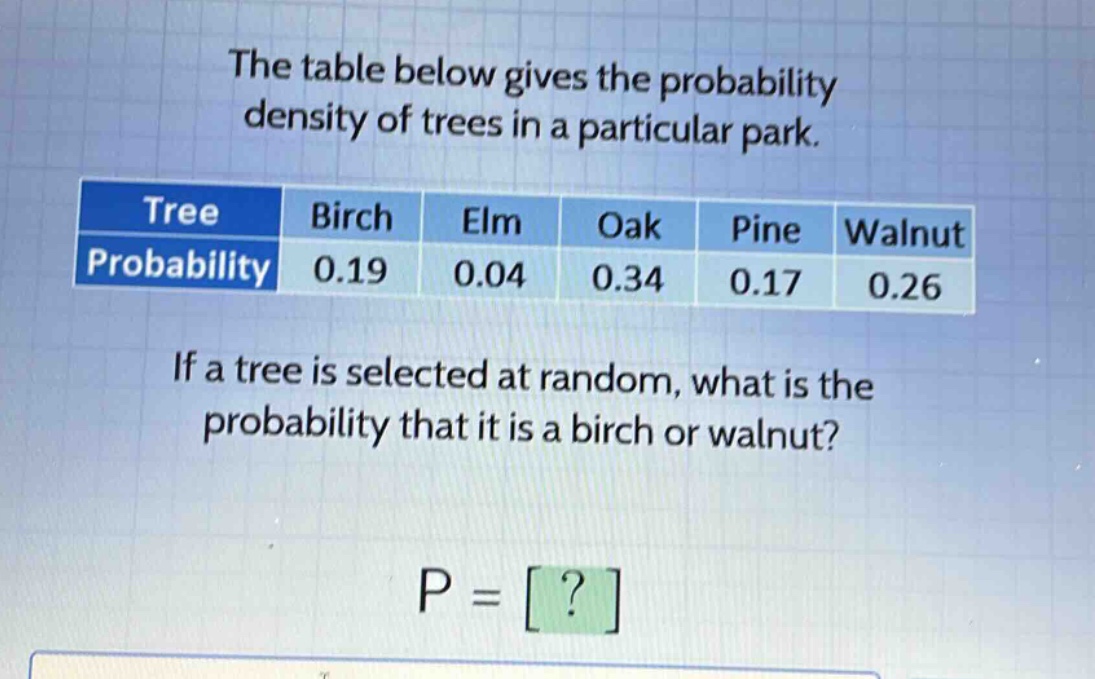
the table below gives the probability density of trees in a particular park.\n| tree | birch | elm | oak | pine | walnut |\n| probability | 0.19 | 0.04 | 0.34 | 0.17 | 0.26 |\nif a tree is selected at random, what is the probability that it is a birch or walnut?\np = ?
Answer
Explanation:
Step1: Identify relevant probabilities
The probability of a birch tree $P(B)=0.19$ and the probability of a walnut tree $P(W)=0.26$.
Step2: Use addition rule for mutually - exclusive events
Since a tree can't be both a birch and a walnut at the same time (mutually - exclusive events), the probability of a birch or walnut is $P(B\cup W)=P(B)+P(W)$. $P(B\cup W)=0.19 + 0.26$
Answer:
$0.45$