the table represents the temperature of a cup of coffee over time.\ntemperature of a cup of coffee\n| time…
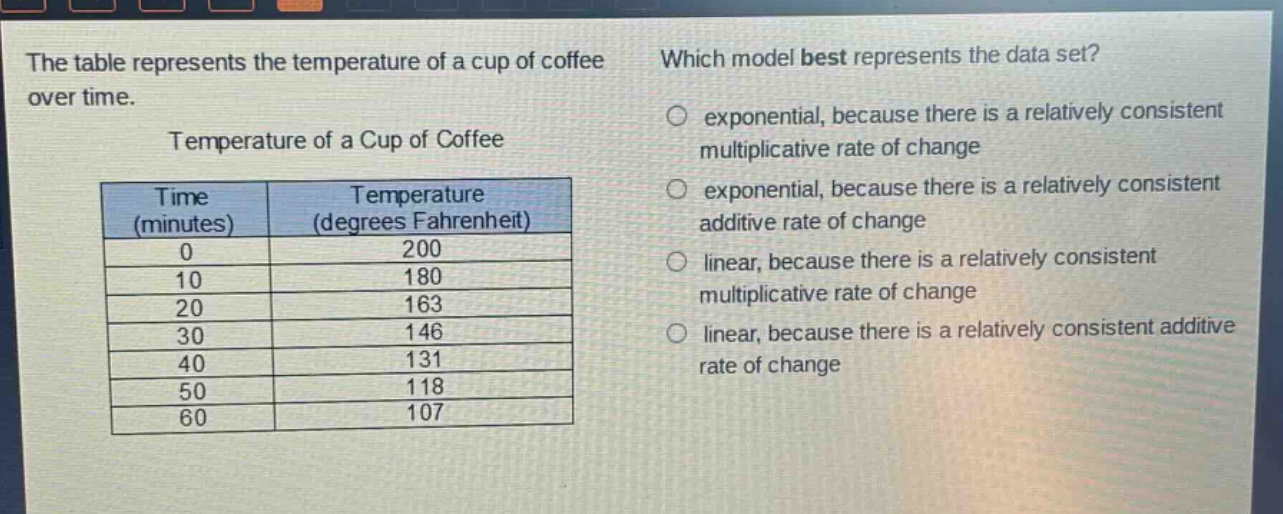
the table represents the temperature of a cup of coffee over time.\ntemperature of a cup of coffee\n| time (minutes) | temperature (degrees fahrenheit) |\n| ---- | ---- |\n| 0 | 200 |\n| 10 | 180 |\n| 20 | 163 |\n| 30 | 146 |\n| 40 | 131 |\n| 50 | 118 |\n| 60 | 107 |\nwhich model best represents the data set?\n- exponential, because there is a relatively consistent multiplicative rate of change\n- exponential, because there is a relatively consistent additive rate of change\n- linear, because there is a relatively consistent multiplicative rate of change\n- linear, because there is a relatively consistent additive rate of change
Answer
Answer:
exponential, because there is a relatively consistent multiplicative rate of change
Explanation:
Step1: Calculate additive rate of change
$180 - 200=- 20$, $163 - 180=-17$, $146 - 163=-17$, $131 - 146=-15$, $118 - 131=-13$, $107 - 118=-11$. Additive rate is not consistent.
Step2: Calculate multiplicative rate of change
$\frac{180}{200}=0.9$, $\frac{163}{180}\approx0.906$, $\frac{146}{163}\approx0.896$, $\frac{131}{146}\approx0.897$, $\frac{118}{131}\approx0.901$, $\frac{107}{118}\approx0.907$. There is a relatively consistent multiplicative rate of change, so it is exponential.