the table represents the temperature of a cup of coffee over time. temperature of a cup of coffee time…
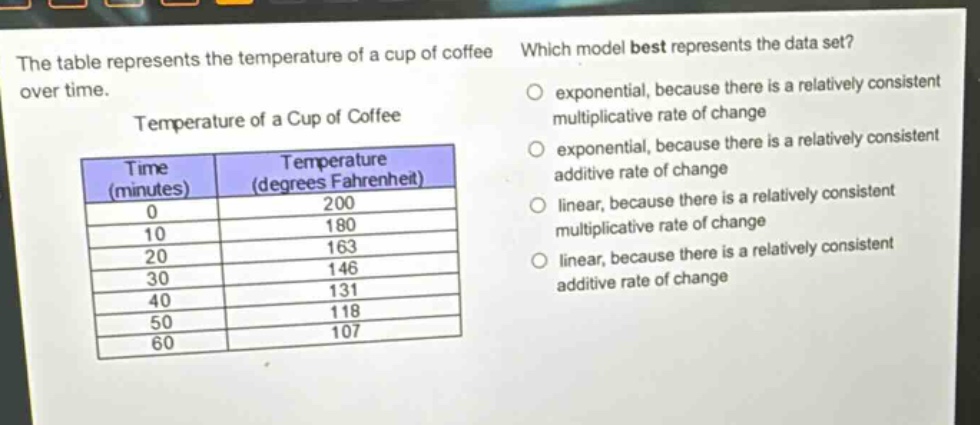
the table represents the temperature of a cup of coffee over time. temperature of a cup of coffee time (minutes) temperature (degrees fahrenheit) 0 200 10 180 20 163 30 146 40 131 50 118 60 107 which model best represents the data set? exponential, because there is a relatively consistent multiplicative rate of change exponential, because there is a relatively consistent additive rate of change linear, because there is a relatively consistent multiplicative rate of change linear, because there is a relatively consistent additive rate of change
Answer
Explanation:
Step1: Check additive rate of change
For linear functions, the additive rate of change (slope) is constant. Calculate the differences in temperature for equal - time intervals. From $t = 0$ to $t = 10$: $180 - 200=-20$. From $t = 10$ to $t = 20$: $163 - 180=-17$. The differences are not the same, so it's not linear based on additive rate of change.
Step2: Check multiplicative rate of change
For exponential functions, the multiplicative rate of change is constant. Calculate the ratios of consecutive temperatures. $\frac{180}{200}=0.9$, $\frac{163}{180}\approx0.906$, $\frac{146}{163}\approx0.896$, $\frac{131}{146}\approx0.897$, $\frac{118}{131}\approx0.901$, $\frac{107}{118}\approx0.907$. The ratios are relatively consistent, indicating an exponential model.
Answer:
exponential, because there is a relatively consistent multiplicative rate of change