this table shows the distance traveled by a car and the cars average speed on different days.\n| day |…
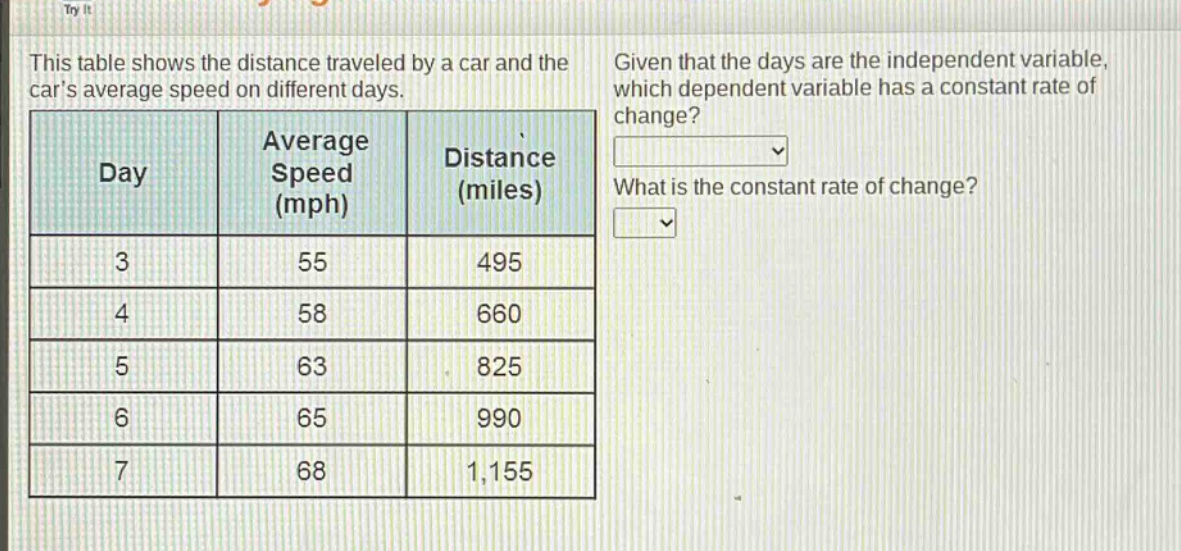
this table shows the distance traveled by a car and the cars average speed on different days.\n| day | average speed (mph) | distance (miles) |\n| ---- | ---- | ---- |\n| 3 | 55 | 495 |\n| 4 | 58 | 660 |\n| 5 | 63 | 825 |\n| 6 | 65 | 990 |\n| 7 | 68 | 1,155 |\ngiven that the days are the independent variable, which dependent variable has a constant rate of change?\nwhat is the constant rate of change?
Answer
Explanation:
Step1: Calculate rate of change for average speed
To find the rate of change of average speed between consecutive days, use the formula $\frac{\Delta y}{\Delta x}=\frac{y_2 - y_1}{x_2 - x_1}$. For days 3 and 4: $\frac{58 - 55}{4 - 3}=3$. For days 4 and 5: $\frac{63 - 58}{5 - 4}=5$. Since the values are not the same, average - speed does not have a constant rate of change.
Step2: Calculate rate of change for distance
For days 3 and 4, $\frac{660 - 495}{4 - 3}=\frac{165}{1}=165$. For days 4 and 5, $\frac{825 - 660}{5 - 4}=\frac{165}{1}=165$. For days 5 and 6, $\frac{990 - 825}{6 - 5}=\frac{165}{1}=165$. For days 6 and 7, $\frac{1155 - 990}{7 - 6}=\frac{165}{1}=165$. The distance has a constant rate of change.
Answer:
Dependent variable: Distance Constant rate of change: 165