the table shows the height, in meters, of an object that is dropped as time passes until the object hits the…
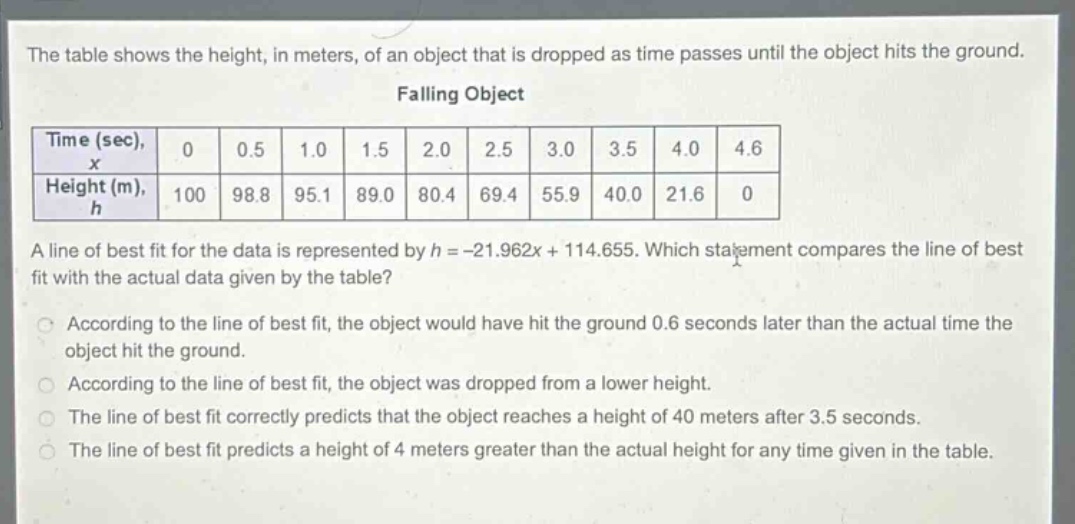
the table shows the height, in meters, of an object that is dropped as time passes until the object hits the ground. falling object\n| time (sec), x | 0 | 0.5 | 1.0 | 1.5 | 2.0 | 2.5 | 3.0 | 3.5 | 4.0 | 4.6 |\n| height (m), h | 100 | 98.8 | 95.1 | 89.0 | 80.4 | 69.4 | 55.9 | 40.0 | 21.6 | 0 |\na line of best fit for the data is represented by h = -21.962x + 114.655. which statement compares the line of best fit with the actual data given by the table?\naccording to the line of best fit, the object would have hit the ground 0.6 seconds later than the actual time the object hit the ground.\naccording to the line of best fit, the object was dropped from a lower height.\nthe line of best fit correctly predicts that the object reaches a height of 40 meters after 3.5 seconds.\nthe line of best fit predicts a height of 4 meters greater than the actual height for any time given in the table.
Answer
Explanation:
Step1: Find ground - hitting time from line of best fit
Set $h = 0$ in $h=-21.962x + 114.655$. So, $0=-21.962x + 114.655$. Then $21.962x=114.655$, and $x=\frac{114.655}{21.962}\approx5.22$ seconds. The actual time the object hits the ground from the table is $4.6$ seconds. The difference is $5.22 - 4.6=0.62\approx0.6$ seconds.
Step2: Check initial - height prediction
When $x = 0$ in $h=-21.962x + 114.655$, $h = 114.655$ meters. The actual initial height from the table is $100$ meters. So, the line of best - fit predicts a higher initial height.
Step3: Check height at $x = 3.5$
When $x = 3.5$ in $h=-21.962x + 114.655$, $h=-21.962\times3.5+114.655=-76.867 + 114.655 = 37.788\neq40$ meters.
Step4: Check height difference for all times
We can't say the line of best - fit predicts a height of 4 meters greater than the actual height for any time. For example, when $x = 0$, the predicted height is $114.655$ and the actual is $100$, the difference is $14.655$ meters.
Answer:
According to the line of best fit, the object would have hit the ground 0.6 seconds later than the actual time the object hit the ground.