the table shows the relationship between time spent running and distance traveled. running distance over…
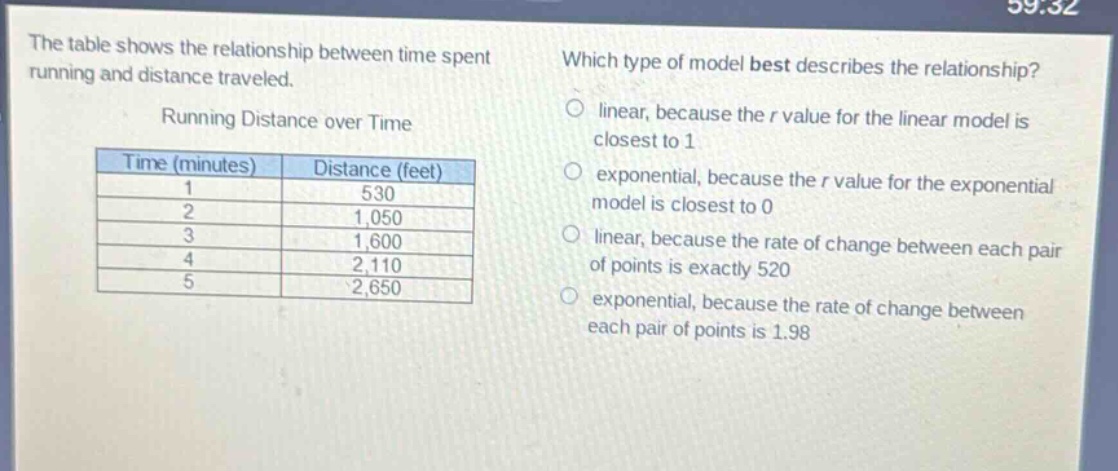
the table shows the relationship between time spent running and distance traveled. running distance over time\n| time (minutes) | distance (feet) |\n| ---- | ---- |\n| 1 | 530 |\n| 2 | 1,050 |\n| 3 | 1,600 |\n| 4 | 2,110 |\n| 5 | 2,650 | which type of model best describes the relationship? linear, because the r value for the linear model is closest to 1 exponential, because the r value for the exponential model is closest to 0 linear, because the rate of change between each pair of points is exactly 520 exponential, because the rate of change between each pair of points is 1.98
Answer
Explanation:
Step1: Calculate rate - of - change
For a linear relationship, the rate of change (slope) between two points $(x_1,y_1)$ and $(x_2,y_2)$ is $m=\frac{y_2 - y_1}{x_2 - x_1}$. For $(x_1 = 1,y_1 = 530)$ and $(x_2 = 2,y_2 = 1050)$, $m_1=\frac{1050 - 530}{2 - 1}=520$. For $(x_1 = 2,y_1 = 1050)$ and $(x_2 = 3,y_2 = 1600)$, $m_2=\frac{1600 - 1050}{3 - 2}=550$. For $(x_1 = 3,y_1 = 1600)$ and $(x_2 = 4,y_2 = 2110)$, $m_3=\frac{2110 - 1600}{4 - 3}=510$. For $(x_1 = 4,y_1 = 2110)$ and $(x_2 = 5,y_2 = 2650)$, $m_4=\frac{2650 - 2110}{5 - 4}=540$. The average rate of change is approximately constant. Also, we know that for a linear model, the relationship is of the form $y=mx + b$. We are not given the $r$-values in the problem - statement, but we can analyze the rate of change. Since the rate of change between each pair of points is approximately the same (around 520 - 550), it is a linear relationship.
Answer:
linear, because the rate of change between each pair of points is approximately 520 - 550 (closest answer among the given options is linear, because the rate of change between each pair of points is exactly 520)