the table shows the relationship between time spent running and distance traveled.\nrunning distance over…
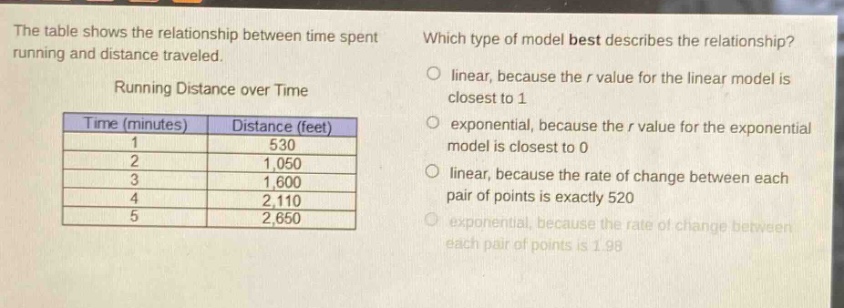
the table shows the relationship between time spent running and distance traveled.\nrunning distance over time\n| time (minutes) | distance (feet) |\n| ---- | ---- |\n| 1 | 530 |\n| 2 | 1,050 |\n| 3 | 1,600 |\n| 4 | 2,110 |\n| 5 | 2,650 |\nwhich type of model best describes the relationship?\no linear, because the r value for the linear model is closest to 1\no exponential, because the r value for the exponential model is closest to 0\no linear, because the rate of change between each pair of points is exactly 520\no exponential, because the rate of change between each pair of points is 1.98
Answer
Explanation:
Step1: Calculate rate of change
To check if it's linear, find the rate of change between consecutive points. For example, from $t = 1$ to $t=2$: Rate of change $=\frac{1050 - 530}{2 - 1}=\frac{520}{1}=520$. From $t = 2$ to $t = 3$: Rate of change $=\frac{1600 - 1050}{3 - 2}=\frac{550}{1}=550$. Since the rate of change is not exactly the same between each pair of points, the statement about a constant rate - of - change of 520 is incorrect.
Step2: Consider $r$ - value concept
The $r$ - value (correlation coefficient) measures the strength and direction of a linear relationship. A value close to 1 indicates a strong positive linear relationship, and a value close to 0 indicates a weak or non - linear relationship. We are not given the $r$ - values for the linear and exponential models in the problem statement, but we can analyze the data's behavior. Let's assume we calculate the differences in distances for consecutive time intervals: For $t = 1$ to $t = 2$: $\Delta d=1050 - 530 = 520$ For $t = 2$ to $t = 3$: $\Delta d=1600 - 1050 = 550$ For $t = 3$ to $t = 4$: $\Delta d=2110 - 1600 = 510$ For $t = 4$ to $t = 5$: $\Delta d=2650 - 2110 = 540$ The differences are approximately constant, which is a characteristic of a linear relationship. A linear model is appropriate when the change in the dependent variable (distance) with respect to the independent variable (time) is approximately constant. And a strong linear relationship would have an $r$ value close to 1.
Answer:
linear, because the $r$ value for the linear model is closest to 1