the table shows the results of a survey in which 10th - grade students were asked how many siblings…
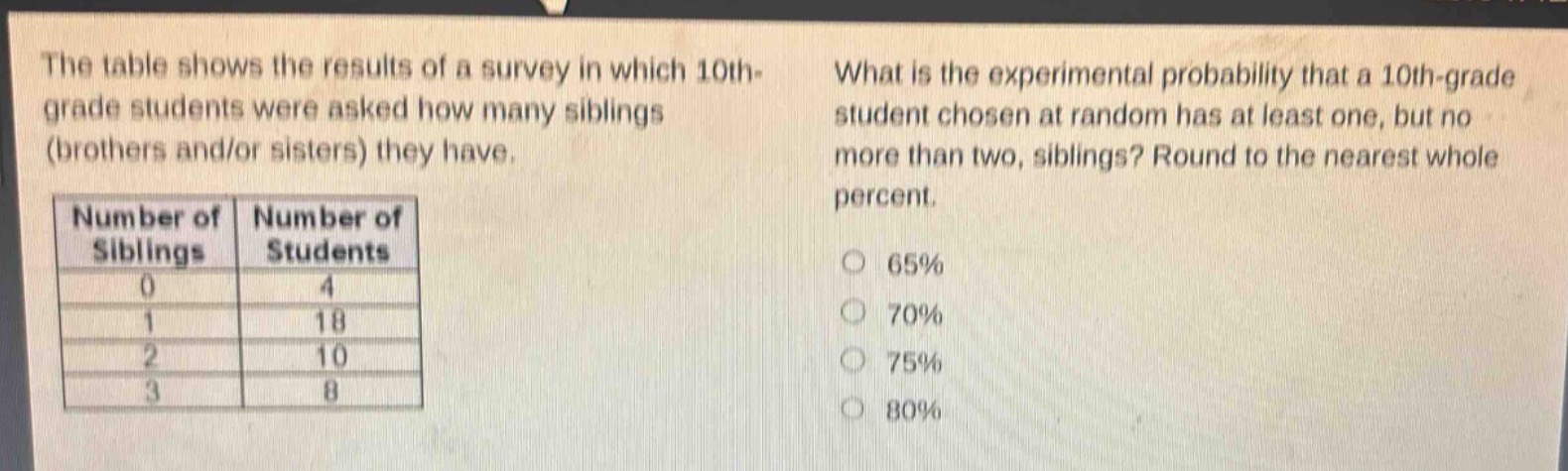
the table shows the results of a survey in which 10th - grade students were asked how many siblings (brothers and/or sisters) they have. what is the experimental probability that a 10th - grade student chosen at random has at least one, but no more than two, siblings? round to the nearest whole percent.\n|number of siblings|number of students|\n|----|----|\n|0|4|\n|1|18|\n|2|10|\n|3|8|\n65% 70% 75% 80%
Answer
Explanation:
Step1: Calculate total number of students
$4 + 18+10 + 8=40$
Step2: Calculate number of students with 1 - 2 siblings
$18 + 10=28$
Step3: Calculate experimental probability
The experimental probability $P=\frac{28}{40}=0.7$
Step4: Convert to percentage
$0.7\times100% = 70%$
Answer:
70%