the table shows the time a patient spends at the dentist and the amount of the bill. bill amount for time…
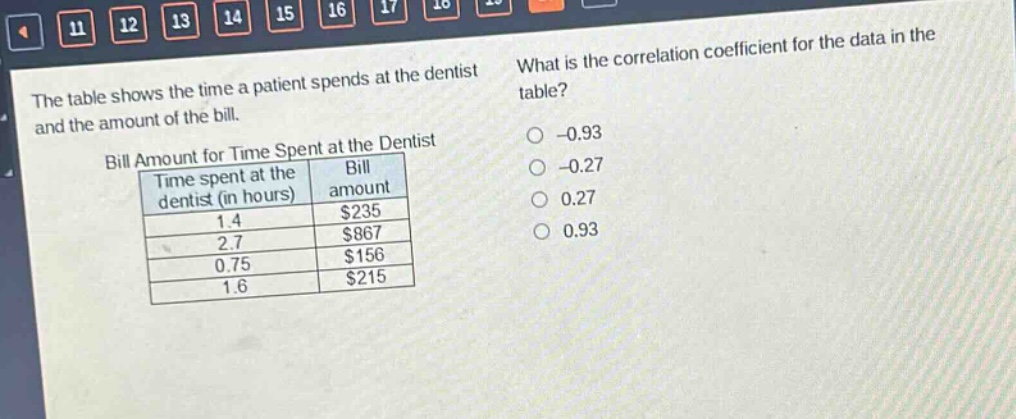
the table shows the time a patient spends at the dentist and the amount of the bill. bill amount for time spent at the dentist\n| time spent at the dentist (in hours) | bill amount |\n| ---- | ---- |\n| 1.4 | $235 |\n| 2.7 | $867 |\n| 0.75 | $156 |\n| 1.6 | $215 |\nwhat is the correlation coefficient for the data in the table?\n- -0.93\n- -0.27\n- 0.27\n- 0.93
Answer
Answer:
We will use a statistical software or a calculator with statistical functions to calculate the correlation coefficient. Let (x) be the time spent at the dentist (in hours) and (y) be the bill amount.
- First, calculate the means of (x) and (y):
- (n = 4)
- (\bar{x}=\frac{1.4 + 2.7+0.75 + 1.6}{4}=\frac{6.45}{4}=1.6125)
- (\bar{y}=\frac{235 + 867+156 + 215}{4}=\frac{1473}{4}=368.25)
- Then, calculate the following sums:
- (\sum_{i = 1}^{n}(x_{i}-\bar{x})(y_{i}-\bar{y})):
- ((1.4 - 1.6125)(235 - 368.25)=(- 0.2125)(-133.25)=28.315625)
- ((2.7-1.6125)(867 - 368.25)=(1.0875)(498.75)=542.0859375)
- ((0.75 - 1.6125)(156 - 368.25)=(-0.8625)(-212.25)=183.065625)
- ((1.6 - 1.6125)(215 - 368.25)=(-0.0125)(-153.25)=1.915625)
- (\sum_{i = 1}^{n}(x_{i}-\bar{x})(y_{i}-\bar{y})=28.315625 + 542.0859375+183.065625 + 1.915625=755.3828125)
- (\sum_{i = 1}^{n}(x_{i}-\bar{x})^{2}):
- ((1.4 - 1.6125)^{2}=(-0.2125)^{2}=0.04515625)
- ((2.7-1.6125)^{2}=(1.0875)^{2}=1.18265625)
- ((0.75 - 1.6125)^{2}=(-0.8625)^{2}=0.74405625)
- ((1.6 - 1.6125)^{2}=(-0.0125)^{2}=0.00015625)
- (\sum_{i = 1}^{n}(x_{i}-\bar{x})^{2}=0.04515625+1.18265625 + 0.74405625+0.00015625=1.972025)
- (\sum_{i = 1}^{n}(y_{i}-\bar{y})^{2}):
- ((235 - 368.25)^{2}=(-133.25)^{2}=17755.5625)
- ((867 - 368.25)^{2}=(498.75)^{2}=248751.5625)
- ((156 - 368.25)^{2}=(-212.25)^{2}=45050.5625)
- ((215 - 368.25)^{2}=(-153.25)^{2}=23485.5625)
- (\sum_{i = 1}^{n}(y_{i}-\bar{y})^{2}=17755.5625+248751.5625+45050.5625+23485.5625=335043.25)
- (\sum_{i = 1}^{n}(x_{i}-\bar{x})(y_{i}-\bar{y})):
- Now, calculate the correlation coefficient (r):
- (r=\frac{\sum_{i = 1}^{n}(x_{i}-\bar{x})(y_{i}-\bar{y})}{\sqrt{\sum_{i = 1}^{n}(x_{i}-\bar{x})^{2}\sum_{i = 1}^{n}(y_{i}-\bar{y})^{2}}})
- (\sqrt{\sum_{i = 1}^{n}(x_{i}-\bar{x})^{2}\sum_{i = 1}^{n}(y_{i}-\bar{y})^{2}}=\sqrt{1.972025\times335043.25}\approx\sqrt{660407.77}\approx812.65)
- (r=\frac{755.3828125}{812.65}\approx0.93)
So the correlation - coefficient is (0.93), and the answer is (0.93).
Explanation:
Step1: Calculate means
(\bar{x}=\frac{\sum_{i = 1}^{n}x_{i}}{n}), (\bar{y}=\frac{\sum_{i = 1}^{n}y_{i}}{n})
Step2: Calculate product - sum
(\sum_{i = 1}^{n}(x_{i}-\bar{x})(y_{i}-\bar{y}))
Step3: Calculate (x) - variance sum
(\sum_{i = 1}^{n}(x_{i}-\bar{x})^{2})
Step4: Calculate (y) - variance sum
(\sum_{i = 1}^{n}(y_{i}-\bar{y})^{2})
Step5: Calculate correlation coefficient
(r=\frac{\sum_{i = 1}^{n}(x_{i}-\bar{x})(y_{i}-\bar{y})}{\sqrt{\sum_{i = 1}^{n}(x_{i}-\bar{x})^{2}\sum_{i = 1}^{n}(y_{i}-\bar{y})^{2}}})