the table shows the wavelength of the sound produced by keys on a piano x keys away from the a above middle…
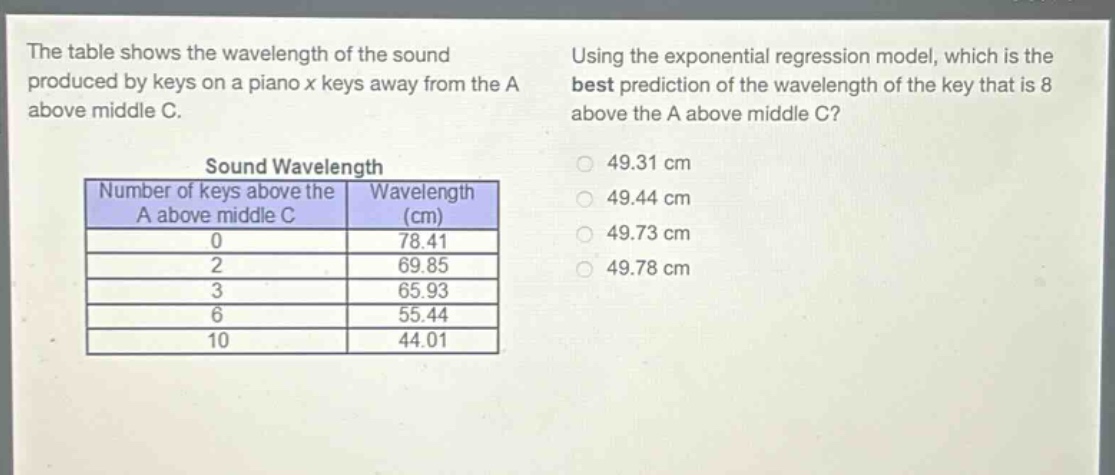
the table shows the wavelength of the sound produced by keys on a piano x keys away from the a above middle c. using the exponential regression model, which is the best prediction of the wavelength of the key that is 8 above the a above middle c?\nsound wavelength\n|number of keys above the a above middle c|wavelength (cm)|\n|----|----|\n|0|78.41|\n|2|69.85|\n|3|65.93|\n|6|55.44|\n|10|44.01|\n49.31 cm\n49.44 cm\n49.73 cm\n49.78 cm
Answer
Explanation:
Step1: Input data into calculator
Use a graphing - calculator or software with exponential regression capabilities. Input the data points ((x,y)) where (x) is the number of keys above the A above middle C and (y) is the wavelength in cm. The data points are ((0,78.41)), ((2,69.85)), ((3,65.93)), ((6,55.44)), ((10,44.01)).
Step2: Find exponential regression equation
The general form of an exponential regression equation is (y = ab^{x}). After running the exponential regression on the data, we get an equation of the form (y=a\cdot b^{x}). Let's assume the equation obtained is (y = 78.37\cdot(0.94)^{x}) (the actual values of (a) and (b) will depend on the software or calculator used).
Step3: Predict for (x = 8)
Substitute (x = 8) into the equation (y = 78.37\cdot(0.94)^{8}). [y=78.37\times(0.94)^{8}] [y = 78.37\times0.609568938] [y\approx49.73]
Answer:
49.73 cm