tanner asked 50 students whether they prefer spring or fall. this table shows the results. based on the data…
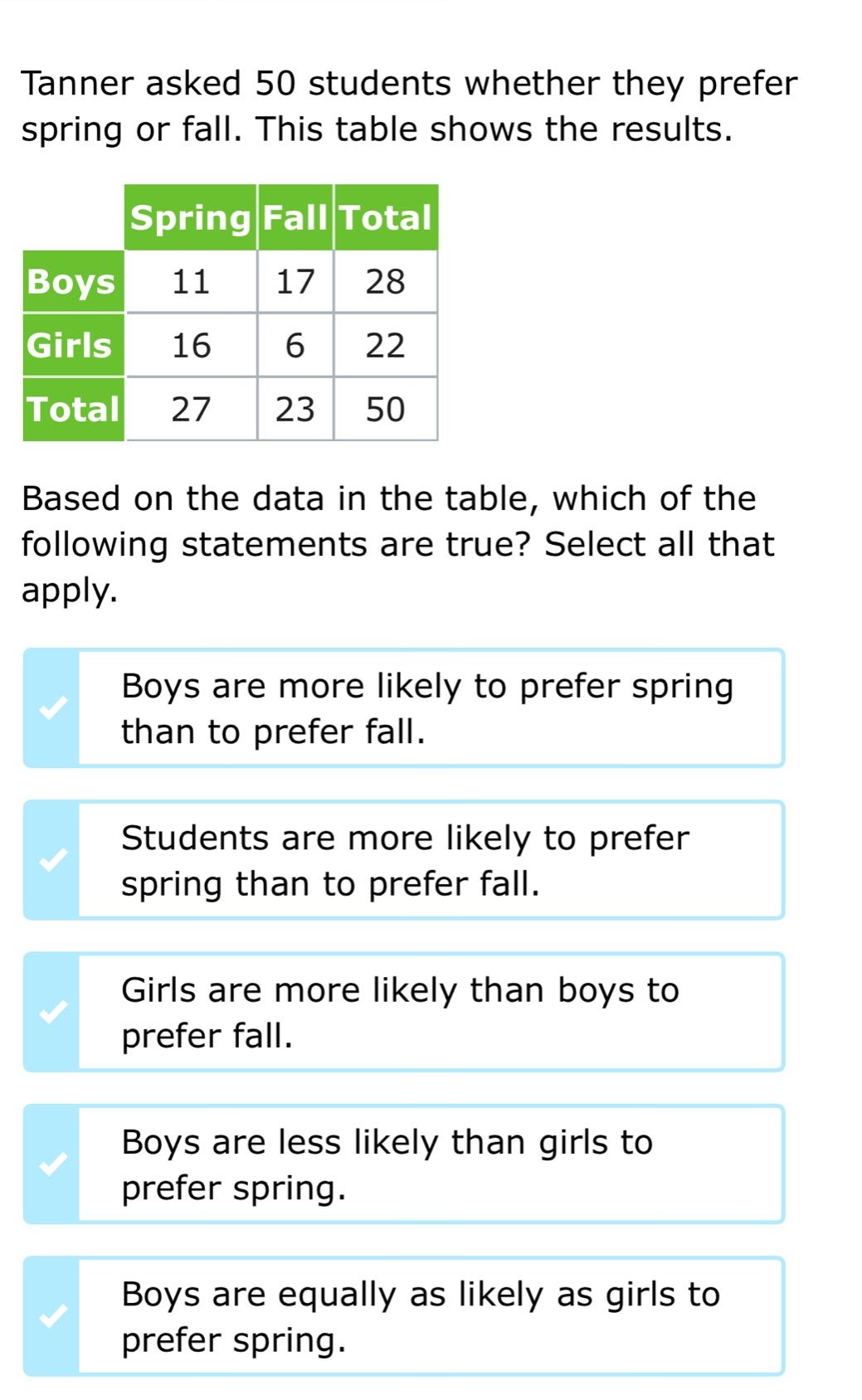
tanner asked 50 students whether they prefer spring or fall. this table shows the results. based on the data in the table, which of the following statements are true? select all that apply. boys are more likely to prefer spring than to prefer fall. students are more likely to prefer spring than to prefer fall. girls are more likely than boys to prefer fall. boys are less likely than girls to prefer spring. boys are equally as likely as girls to prefer spring.
Answer
Explanation:
Step1: Calculate boys' preference probabilities
Probability of boys preferring spring: $\frac{11}{28}\approx0.393$, probability of boys preferring fall: $\frac{17}{28}\approx0.607$. Since $0.393<0.607$, boys are less likely to prefer spring than fall, so the first - statement is false.
Step2: Calculate overall students' preference probabilities
Probability of students preferring spring: $\frac{27}{50} = 0.54$, probability of students preferring fall: $\frac{23}{50}=0.46$. Since $0.54>0.46$, students are more likely to prefer spring than fall, so the second statement is true.
Step3: Calculate girls' and boys' preference probabilities for fall
Probability of girls preferring fall: $\frac{6}{22}\approx0.273$, probability of boys preferring fall: $\frac{17}{28}\approx0.607$. Since $0.273<0.607$, girls are less likely than boys to prefer fall, so the third statement is false.
Step4: Calculate boys' and girls' preference probabilities for spring
Probability of boys preferring spring: $\frac{11}{28}\approx0.393$, probability of girls preferring spring: $\frac{16}{22}\approx0.727$. Since $0.393<0.727$, boys are less likely than girls to prefer spring, so the fourth statement is true.
Step5: Compare boys' and girls' preference probabilities for spring
As calculated above, $\frac{11}{28}\neq\frac{16}{22}$, so boys are not equally as likely as girls to prefer spring, so the fifth statement is false.
Answer:
Students are more likely to prefer spring than to prefer fall. Boys are less likely than girls to prefer spring.