a teacher claims that his coffee cools to a temperature of 100 degrees fahrenheit in 5 minutes after he…
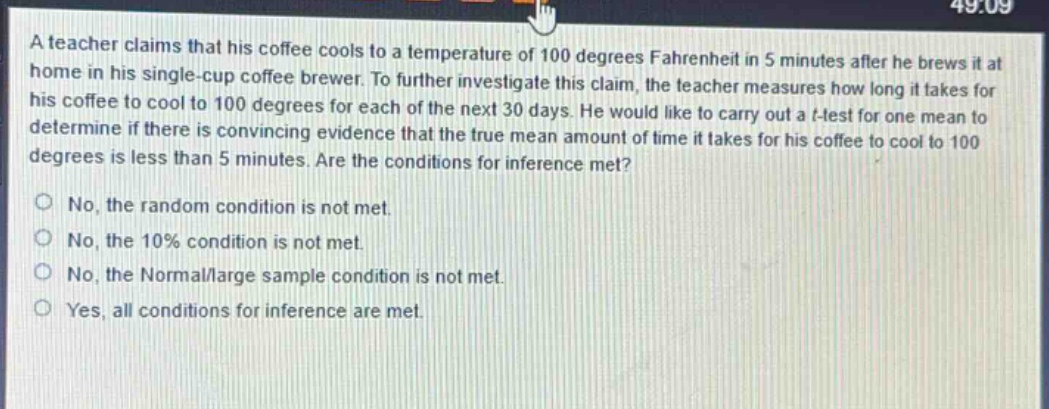
a teacher claims that his coffee cools to a temperature of 100 degrees fahrenheit in 5 minutes after he brews it at home in his single - cup coffee brewer. to further investigate this claim, the teacher measures how long it takes for his coffee to cool to 100 degrees for each of the next 30 days. he would like to carry out a t - test for one mean to determine if there is convincing evidence that the true mean amount of time it takes for his coffee to cool to 100 degrees is less than 5 minutes. are the conditions for inference met?\nno, the random condition is not met.\nno, the 10% condition is not met.\nno, the normal/large sample condition is not met.\nyes, all conditions for inference are met.
Answer
Brief Explanations:
- Random condition: There is no indication that the 30 - day measurements are a random sample. Just measuring over 30 consecutive days does not imply random selection.
- 10% condition: Since we are not sampling from a finite population in a way that would require checking the 10% condition (e.g., we are not sampling from a specific, finite set of coffee - cooling events), this is not the main issue here.
- Normal/large - sample condition: The sample size (n = 30). By the Central Limit Theorem, for a sample size of (n=30), the sampling distribution of the sample mean will be approximately normal even if the population distribution is not normal. But the lack of randomness is the key problem.
Answer:
No, the random condition is not met.