a teacher has four books—a, b, c, and d—to assign to four students in any order he prefers. set s includes…
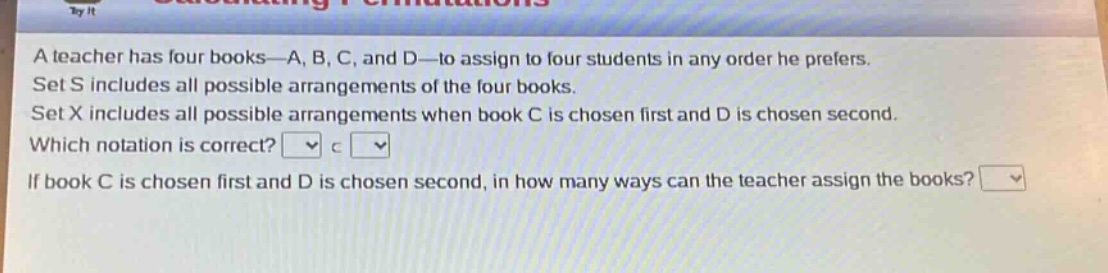
a teacher has four books—a, b, c, and d—to assign to four students in any order he prefers. set s includes all possible arrangements of the four books. set x includes all possible arrangements when book c is chosen first and d is chosen second. which notation is correct? if book c is chosen first and d is chosen second, in how many ways can the teacher assign the books?
Answer
Explanation:
Step1: Analyze remaining books
When C is first and D is second, there are 2 remaining books (A and B).
Step2: Calculate number of arrangements
The number of ways to arrange the remaining 2 books is given by the permutation formula for (n = 2) distinct objects. The number of permutations of (n) distinct objects is (n!). Here (n=2), so the number of arrangements is (2! = 2\times1=2).
Answer:
2