ten identical slips of paper each contain one number from one to ten, inclusive. the papers are put into a…
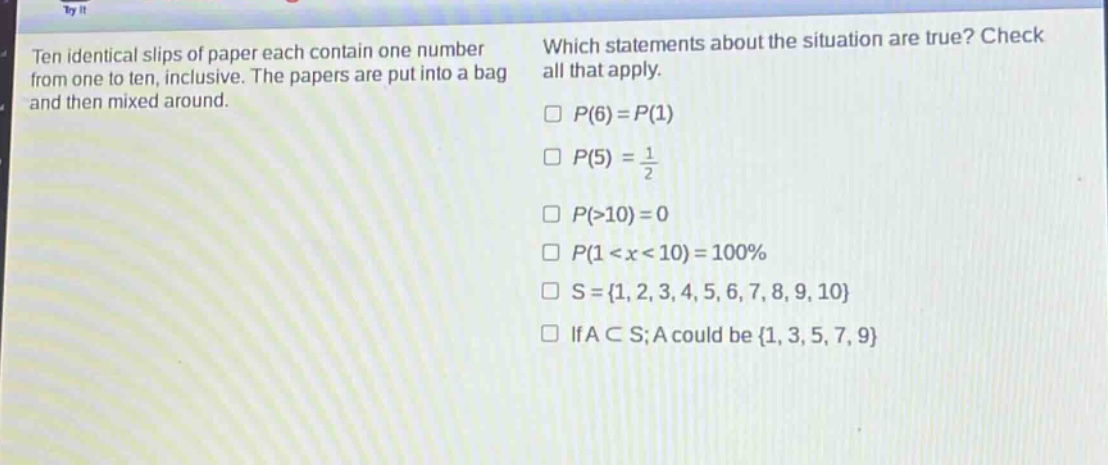
ten identical slips of paper each contain one number from one to ten, inclusive. the papers are put into a bag and then mixed around. which statements about the situation are true? check all that apply. p(6)=p(1) p(5) = 1/2 p(>10)=0 p(1<x<10)=100% s={1,2,3,4,5,6,7,8,9,10} if a⊂s;a could be {1,3,5,7,9}
Answer
Explanation:
Step1: Calculate probability of single - number selection
The probability of selecting any single number from 1 to 10 is calculated using the formula $P(x)=\frac{\text{Number of favorable outcomes}}{\text{Total number of outcomes}}$. Since there is 1 favorable outcome for each number and 10 total outcomes, for $x = 1$ and $x = 6$, $P(6)=\frac{1}{10}$ and $P(1)=\frac{1}{10}$, so $P(6)=P(1)$.
Step2: Analyze $P(5)$
$P(5)=\frac{1}{10}\neq\frac{1}{2}$.
Step3: Analyze $P(> 10)$
Since the numbers in the bag are from 1 to 10, there are no numbers greater than 10. So $P(>10)=\frac{0}{10} = 0$.
Step4: Analyze $P(1 < x<10)$
The numbers that satisfy $1 < x<10$ are 2, 3, 4, 5, 6, 7, 8, 9. There are 8 such numbers. So $P(1 < x<10)=\frac{8}{10}=80%\neq100%$.
Step5: Define the sample space
The sample space $S$ is the set of all possible outcomes. Here, $S={1,2,3,4,5,6,7,8,9,10}$.
Step6: Analyze subset
If $A\subset S$, $A$ can be a subset of $S$. The set ${1,3,5,7,9}$ is a subset of $S$.
Answer:
$P(6)=P(1)$, $P(>10)=0$, $S = {1,2,3,4,5,6,7,8,9,10}$, If $A\subset S$; $A$ could be ${1,3,5,7,9}$