a test consists of 15 true/false questions. to pass the test, a student must answer at least 11 questions…
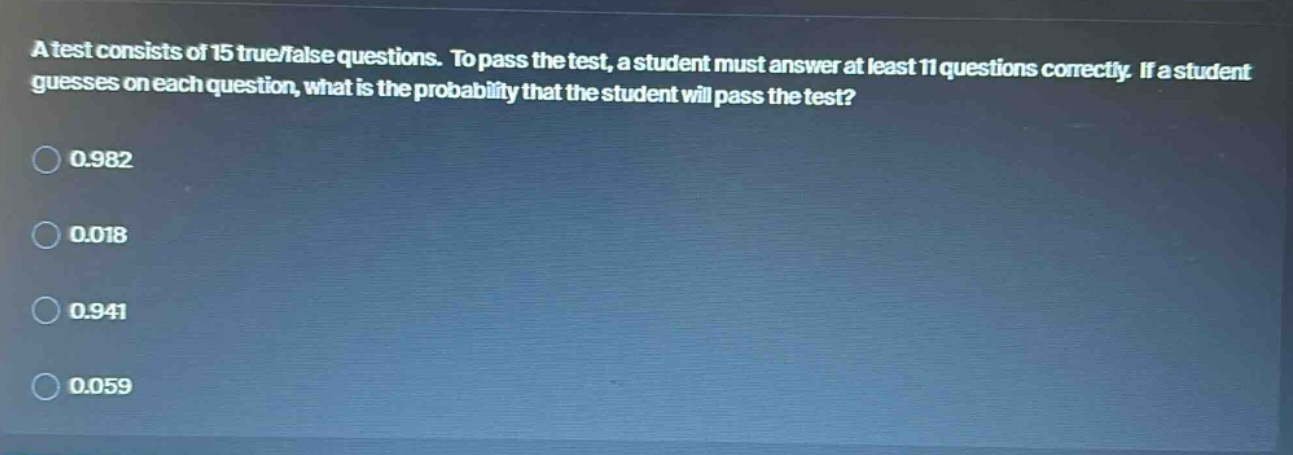
a test consists of 15 true/false questions. to pass the test, a student must answer at least 11 questions correctly. if a student guesses on each question, what is the probability that the student will pass the test?\n0.982\n0.018\n0.941\n0.059
Answer
Explanation:
Step1: Identify the binomial probability formula
The binomial probability formula is $P(X = k)=C(n,k)\times p^{k}\times(1 - p)^{n - k}$, where $n$ is the number of trials, $k$ is the number of successes, $p$ is the probability of success on a single - trial, and $C(n,k)=\frac{n!}{k!(n - k)!}$. Here, $n = 15$, $p=\frac{1}{2}$ (since it's a true - false question), and we want to find $P(X\geq11)=P(X = 11)+P(X = 12)+P(X = 13)+P(X = 14)+P(X = 15)$.
Step2: Calculate $C(n,k)$ for each $k$
For $k = 11$: $C(15,11)=\frac{15!}{11!(15 - 11)!}=\frac{15!}{11!4!}=\frac{15\times14\times13\times12}{4\times3\times2\times1}=1365$ $P(X = 11)=C(15,11)\times(\frac{1}{2})^{11}\times(1-\frac{1}{2})^{15 - 11}=1365\times(\frac{1}{2})^{11}\times(\frac{1}{2})^{4}=1365\times(\frac{1}{2})^{15}$ For $k = 12$: $C(15,12)=\frac{15!}{12!(15 - 12)!}=\frac{15!}{12!3!}=\frac{15\times14\times13}{3\times2\times1}=455$ $P(X = 12)=C(15,12)\times(\frac{1}{2})^{12}\times(1-\frac{1}{2})^{15 - 12}=455\times(\frac{1}{2})^{12}\times(\frac{1}{2})^{3}=455\times(\frac{1}{2})^{15}$ For $k = 13$: $C(15,13)=\frac{15!}{13!(15 - 13)!}=\frac{15!}{13!2!}=\frac{15\times14}{2\times1}=105$ $P(X = 13)=C(15,13)\times(\frac{1}{2})^{13}\times(1-\frac{1}{2})^{15 - 13}=105\times(\frac{1}{2})^{13}\times(\frac{1}{2})^{2}=105\times(\frac{1}{2})^{15}$ For $k = 14$: $C(15,14)=\frac{15!}{14!(15 - 14)!}=15$ $P(X = 14)=C(15,14)\times(\frac{1}{2})^{14}\times(1-\frac{1}{2})^{15 - 14}=15\times(\frac{1}{2})^{14}\times(\frac{1}{2})^{1}=15\times(\frac{1}{2})^{15}$ For $k = 15$: $C(15,15)=\frac{15!}{15!(15 - 15)!}=1$ $P(X = 15)=C(15,15)\times(\frac{1}{2})^{15}\times(1-\frac{1}{2})^{15 - 15}=1\times(\frac{1}{2})^{15}$
Step3: Calculate $P(X\geq11)$
$P(X\geq11)=(1365 + 455+105 + 15+1)\times(\frac{1}{2})^{15}$ $=(1941)\times\frac{1}{32768}\approx0.059$
Answer:
0.059