a textbook company states that the average time a student needs to take a quiz from its book is 30 minutes…
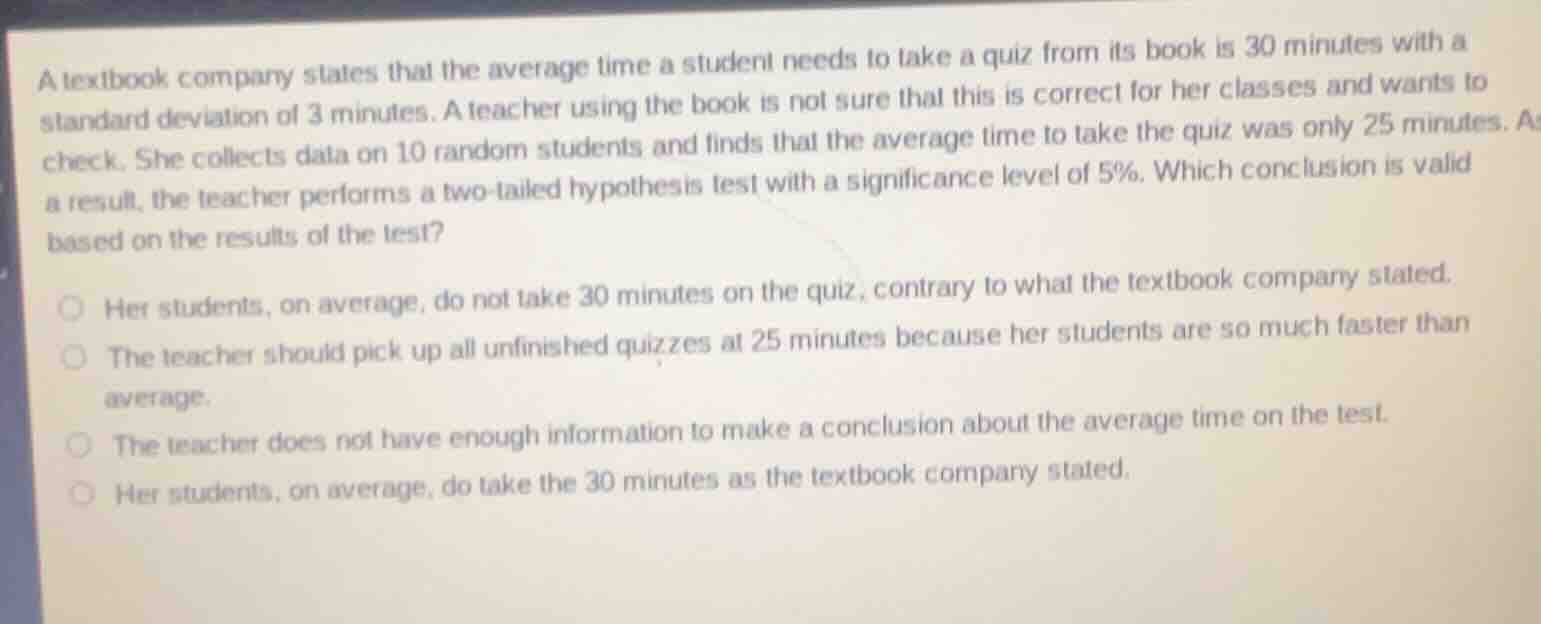
a textbook company states that the average time a student needs to take a quiz from its book is 30 minutes with a standard deviation of 3 minutes. a teacher using the book is not sure that this is correct for her classes and wants to check. she collects data on 10 random students and finds that the average time to take the quiz was only 25 minutes. as a result, the teacher performs a two-tailed hypothesis test with a significance level of 5%. which conclusion is valid based on the results of the test?\n\n- her students, on average, do not take 30 minutes on the quiz, contrary to what the textbook company stated.\n- the teacher should pick up all unfinished quizzes at 25 minutes because her students are so much faster than average.\n- the teacher does not have enough information to make a conclusion about the average time on the test.\n- her students, on average, do take the 30 minutes as the textbook company stated.
Answer
Explanation:
Step1: State the null and alternative hypotheses
$$H_0: \mu = 30$$ $$H_a: \mu \neq 30$$
Step2: Identify the given parameters
Population mean $\mu = 30$, population standard deviation $\sigma = 3$, sample size $n = 10$, and sample mean $\bar{x} = 25$.
Step3: Calculate the test statistic (z-score)
$$z = \frac{\bar{x} - \mu}{\frac{\sigma}{\sqrt{n}}} = \frac{25 - 30}{\frac{3}{\sqrt{10}}} \approx \frac{-5}{0.9487} \approx -5.27$$
Step4: Determine the critical values
For a two-tailed test at $\alpha = 0.05$, the critical values are $\pm 1.96$.
Step5: Compare the test statistic to critical values
Since $|-5.27| > 1.96$, the test statistic falls in the rejection region. We reject the null hypothesis.
Answer:
Her students, on average, do not take 30 minutes on the quiz, contrary to what the textbook company stated.