the theoretical probability of a couple having a baby girl is $\frac{1}{2}$. what is $p(\text{girl, girl…
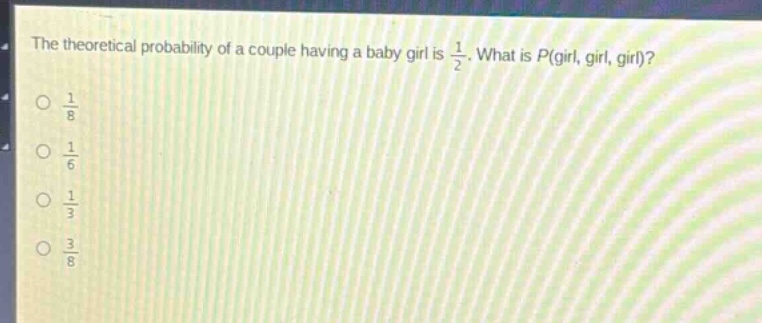
the theoretical probability of a couple having a baby girl is $\frac{1}{2}$. what is $p(\text{girl, girl, girl})$?\n$\frac{1}{8}$\n$\frac{1}{6}$\n$\frac{1}{3}$\n$\frac{3}{8}$
Answer
Explanation:
Step1: Identify independent events
The events of having a girl in each birth are independent.
Step2: Use probability - multiplication rule for independent events
If the probability of having a girl in one birth is $P = \frac{1}{2}$, and we want to find the probability of having a girl in three consecutive births. The multiplication rule for independent events states that if $A$, $B$, and $C$ are independent events, then $P(A\cap B\cap C)=P(A)\times P(B)\times P(C)$. Here, $A$, $B$, and $C$ are the events of having a girl in the first, second, and third birth respectively. So $P(\text{girl, girl, girl})=\frac{1}{2}\times\frac{1}{2}\times\frac{1}{2}$.
Step3: Calculate the result
$\frac{1}{2}\times\frac{1}{2}\times\frac{1}{2}=\frac{1}{8}$
Answer:
$\frac{1}{8}$