the theoretical probability of an event occurring is $\frac{2}{5}$. which best describes the experimental…
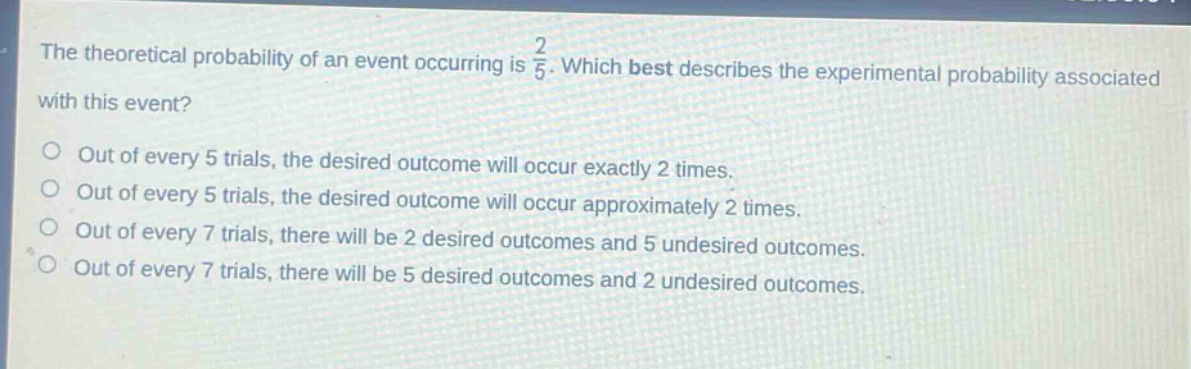
the theoretical probability of an event occurring is $\frac{2}{5}$. which best describes the experimental probability associated with this event?\nout of every 5 trials, the desired outcome will occur exactly 2 times.\nout of every 5 trials, the desired outcome will occur approximately 2 times.\nout of every 7 trials, there will be 2 desired outcomes and 5 undesired outcomes.\nout of every 7 trials, there will be 5 desired outcomes and 2 undesired outcomes.
Answer
Explanation:
Step1: Understand theoretical probability
Theoretical probability $\frac{2}{5}$ means in an ideal - situation, for a large number of trials, the proportion of desired outcomes is $\frac{2}{5}$. But in experimental probability, it is an approximation.
Step2: Analyze each option
- Option 1: In experimental probability, we cannot say exactly 2 times out of 5 trials. It is an approximation.
- Option 2: Since experimental probability is an approximation of theoretical probability, out of every 5 trials, the desired outcome will occur approximately 2 times. This is correct.
- Option 3: The theoretical probability is $\frac{2}{5}$, not related to 7 - trial situation in this way.
- Option 4: This does not match the given theoretical probability $\frac{2}{5}$.
Answer:
Out of every 5 trials, the desired outcome will occur approximately 2 times.