there are three choices of fruit are bananas, pears, and oranges. if the probability of getting a banana is…
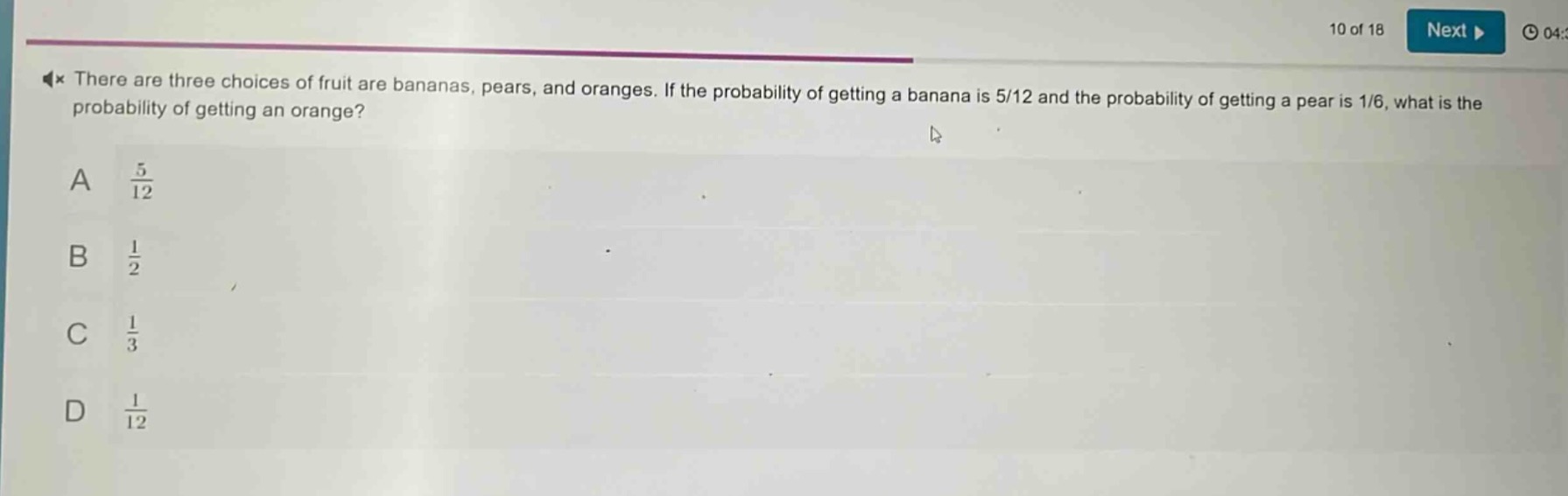
there are three choices of fruit are bananas, pears, and oranges. if the probability of getting a banana is 5/12 and the probability of getting a pear is 1/6, what is the probability of getting an orange?\na $\frac{5}{12}$\nb $\frac{1}{2}$\nc $\frac{1}{3}$\nd $\frac{1}{12}$
Answer
Explanation:
Step1: Find a common denominator
The common denominator of (12) and (6) is (12). Rewrite (\frac{1}{6}) as (\frac{2}{12}).
Step2: Calculate the probability of getting an orange
The sum of all probabilities is (1) (or (\frac{12}{12})). Subtract the probabilities of banana ((\frac{5}{12})) and pear ((\frac{2}{12})) from (1). [ \begin{align*} P(\text{orange})&=1-\frac{5}{12}-\frac{1}{6}\ &=\frac{12}{12}-\frac{5}{12}-\frac{2}{12}\ &=\frac{12 - 5- 2}{12}\ &=\frac{5}{12} \end{align*} ]
Answer:
A. (\frac{5}{12})