tia performed an experiment where she flipped a coin 200 times. the coin landed heads up 92 times and tails…
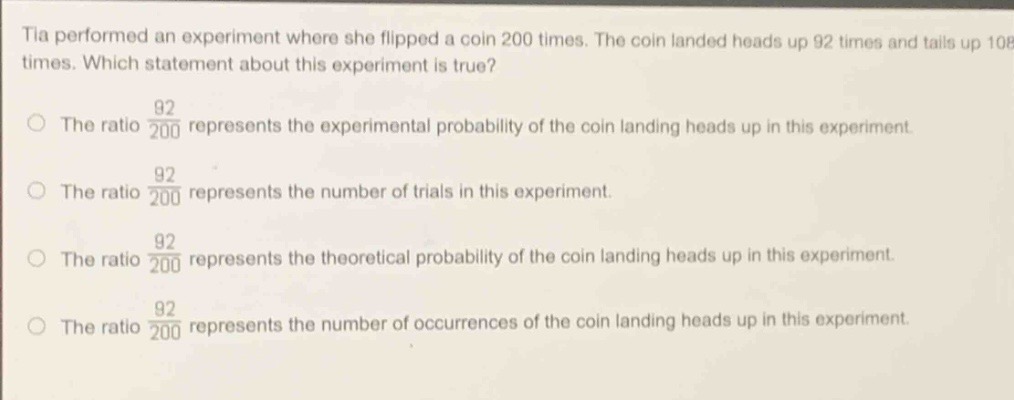
tia performed an experiment where she flipped a coin 200 times. the coin landed heads up 92 times and tails up 108 times. which statement about this experiment is true?\nthe ratio $\frac{92}{200}$ represents the experimental probability of the coin landing heads up in this experiment.\nthe ratio $\frac{92}{200}$ represents the number of trials in this experiment.\nthe ratio $\frac{92}{200}$ represents the theoretical probability of the coin landing heads up in this experiment.\nthe ratio $\frac{92}{200}$ represents the number of occurrences of the coin landing heads up in this experiment.
Answer
Explanation:
Step1: Recall probability concepts
Experimental probability = $\frac{\text{Number of favorable outcomes}}{\text{Total number of trials}}$.
Step2: Identify values in the experiment
Number of favorable outcomes (heads) = 92, total number of trials = 200.
Step3: Determine the meaning of the ratio
The ratio $\frac{92}{200}$ is the experimental probability of getting heads as it is $\frac{\text{Number of heads}}{\text{Total flips}}$.
Answer:
The ratio $\frac{92}{200}$ represents the experimental probability of the coin landing heads up in this experiment.