the time needed for passengers to board the twisting thunder roller coaster is skewed right with a mean of…
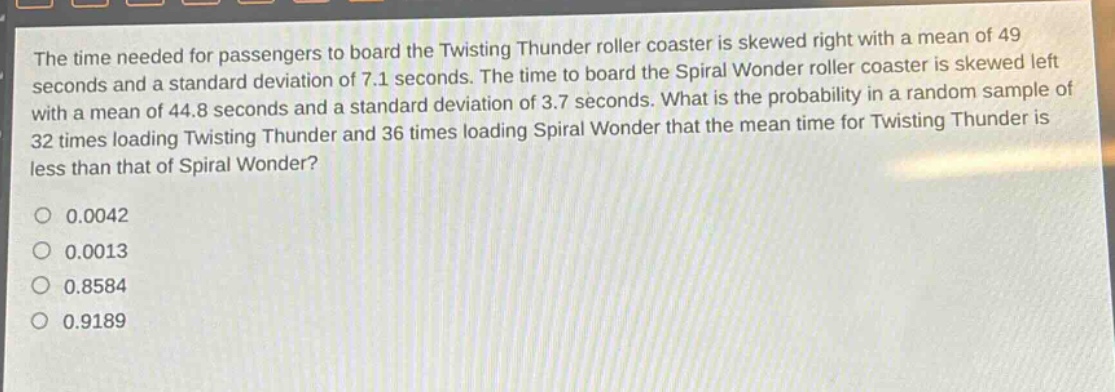
the time needed for passengers to board the twisting thunder roller coaster is skewed right with a mean of 49 seconds and a standard deviation of 7.1 seconds. the time to board the spiral wonder roller coaster is skewed left with a mean of 44.8 seconds and a standard deviation of 3.7 seconds. what is the probability in a random sample of 32 times loading twisting thunder and 36 times loading spiral wonder that the mean time for twisting thunder is less than that of spiral wonder?\n0.0042\n0.0013\n0.8584\n0.9189
Answer
Explanation:
Step1: Define variables
Let $\bar{X}_1$ be the sample - mean time for Twisting Thunder and $\bar{X}_2$ be the sample - mean time for Spiral Wonder. We know that $\mu_1 = 49$, $\sigma_1 = 7.1$, $n_1 = 32$, $\mu_2 = 44.8$, $\sigma_2 = 3.7$, $n_2 = 36$. The mean of the sampling distribution of $\bar{X}_1-\bar{X}_2$ is $\mu=\mu_1 - \mu_2=49 - 44.8 = 4.2$. The standard deviation of the sampling distribution of $\bar{X}_1-\bar{X}_2$ is $\sigma=\sqrt{\frac{\sigma_1^{2}}{n_1}+\frac{\sigma_2^{2}}{n_2}}=\sqrt{\frac{7.1^{2}}{32}+\frac{3.7^{2}}{36}}$. First, calculate $\frac{7.1^{2}}{32}+\frac{3.7^{2}}{36}$: $\frac{7.1^{2}}{32}=\frac{50.41}{32}\approx1.5753$ $\frac{3.7^{2}}{36}=\frac{13.69}{36}\approx0.3803$ $\frac{7.1^{2}}{32}+\frac{3.7^{2}}{36}\approx1.5753 + 0.3803=1.9556$ $\sigma=\sqrt{1.9556}\approx1.4$
Step2: Standardize the value
We want to find $P(\bar{X}_1<\bar{X}_2)$, which is equivalent to $P(\bar{X}_1 - \bar{X}_2<0)$. Let $Z=\frac{(\bar{X}_1 - \bar{X}_2)-\mu}{\sigma}$. Substituting the values, we get $Z=\frac{0 - 4.2}{1.4}=- 3$.
Step3: Find the probability
We know that $P(Z < - 3)$ can be found using the standard - normal distribution table. From the standard - normal table, $P(Z < - 3)=0.0013$.
Answer:
0.0013