timmy could follow two main routes to get to school. timmy believes that route 1 is faster than route 2. to…
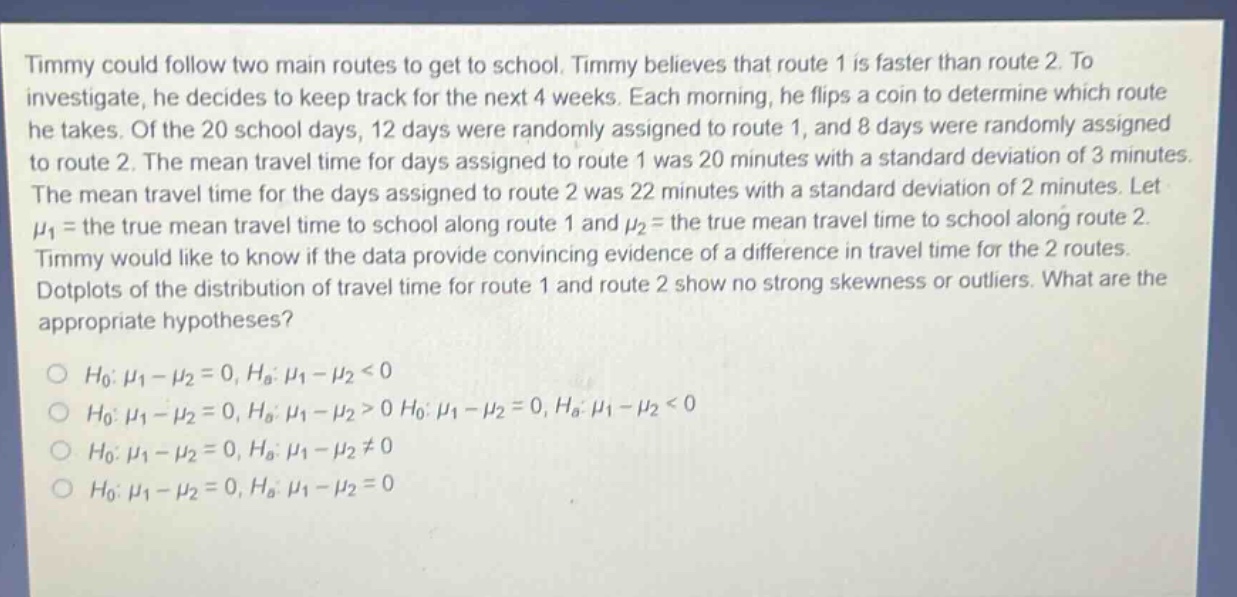
timmy could follow two main routes to get to school. timmy believes that route 1 is faster than route 2. to investigate, he decides to keep track for the next 4 weeks. each morning, he flips a coin to determine which route he takes. of the 20 school days, 12 days were randomly assigned to route 1, and 8 days were randomly assigned to route 2. the mean travel time for days assigned to route 1 was 20 minutes with a standard deviation of 3 minutes. the mean travel time for the days assigned to route 2 was 22 minutes with a standard deviation of 2 minutes. let $mu_1$ = the true mean travel time to school along route 1 and $mu_2$ = the true mean travel time to school along route 2. timmy would like to know if the data provide convincing evidence of a difference in travel time for the 2 routes. dotplots of the distribution of travel time for route 1 and route 2 show no strong skewness or outliers. what are the appropriate hypotheses?\n$h_0: mu_1 - mu_2 = 0, h_a: mu_1 - mu_2 < 0$\n$h_0: mu_1 - mu_2 = 0, h_a: mu_1 - mu_2 > 0 h_0: mu_1 - mu_2 = 0, h_a: mu_1 - mu_2 < 0$\n$h_0: mu_1 - mu_2 = 0, h_a: mu_1 - mu_2 \neq 0$\n$h_0: mu_1 - mu_2 = 0, h_a: mu_1 - mu_2 = 0$
Answer
Brief Explanations:
The null hypothesis $H_0$ is typically a statement of no - difference. Here, it is that the true mean travel times of the two routes are equal, i.e., $\mu_1-\mu_2 = 0$. The alternative hypothesis $H_a$ is what we are trying to find evidence for. Since Timmy wants to know if there is a difference (not specifying a direction like route 1 being faster or slower), the alternative hypothesis is $\mu_1-\mu_2\neq0$.
Answer:
$H_0:\mu_1 - \mu_2=0, H_a:\mu_1 - \mu_2\neq0$