a tire company wants to determine if tires made with a new type of tread will last longer than tires made…
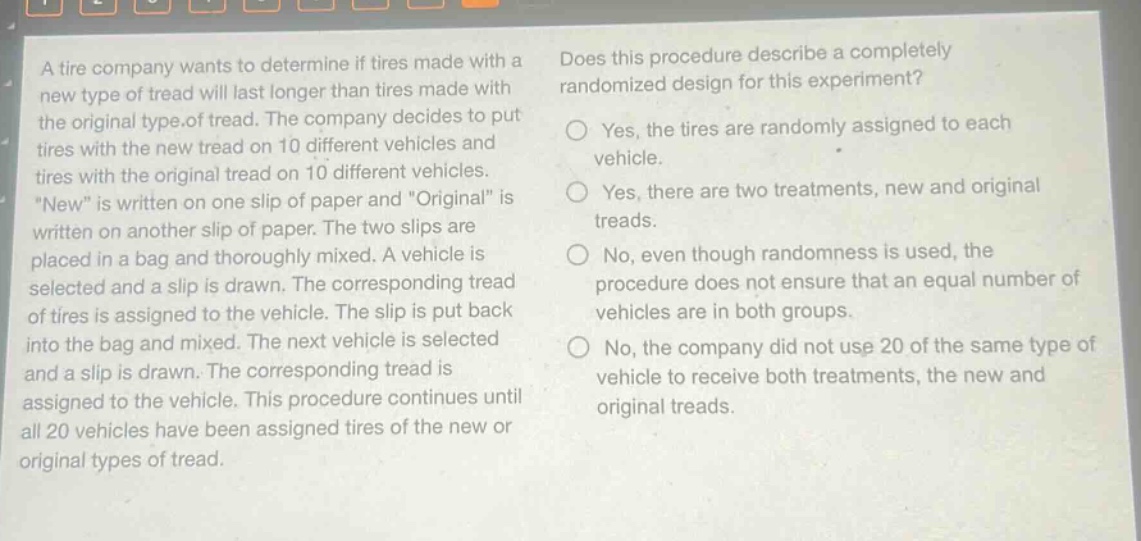
a tire company wants to determine if tires made with a new type of tread will last longer than tires made with the original type of tread. the company decides to put tires with the new tread on 10 different vehicles and tires with the original tread on 10 different vehicles. “new” is written on one slip of paper and “original” is written on another slip of paper. the two slips are placed in a bag and thoroughly mixed. a vehicle is selected and a slip is drawn. the corresponding tread of tires is assigned to the vehicle. the slip is put back into the bag and mixed. the next vehicle is selected and a slip is drawn. the corresponding tread is assigned to the vehicle. this procedure continues until all 20 vehicles have been assigned tires of the new or original types of tread. does this procedure describe a completely randomized design for this experiment? yes, the tires are randomly assigned to each vehicle. yes, there are two treatments, new and original treads. no, even though randomness is used, the procedure does not ensure that an equal number of vehicles are in both groups. no, the company did not use 20 of the same type of vehicle to receive both treatments, the new and original treads.
Answer
Brief Explanations:
In a completely randomized design, treatments should be randomly assigned to experimental units. Here, the two types of tire treads (new and original) are randomly assigned to 20 vehicles. However, for a proper comparison, it is better if the same type of vehicle can receive both treatments to control for vehicle - type variability. Since the company didn't use 20 of the same type of vehicle to receive both treatments, it's not a completely randomized design in the best - practice sense.
Answer:
No, the company did not use 20 of the same type of vehicle to receive both treatments, the new and original treads.