2) a tortoise and a hare are running a race, just like they do every day. over many years, the tortoise has…
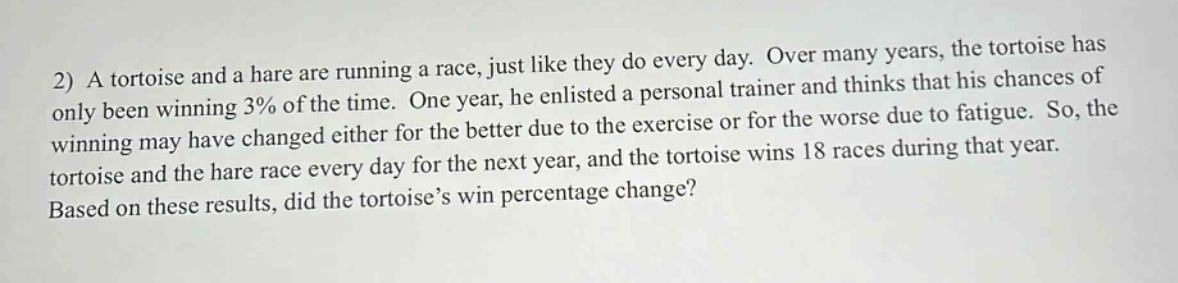
2) a tortoise and a hare are running a race, just like they do every day. over many years, the tortoise has only been winning 3% of the time. one year, he enlisted a personal trainer and thinks that his chances of winning may have changed either for the better due to the exercise or for the worse due to fatigue. so, the tortoise and the hare race every day for the next year, and the tortoise wins 18 races during that year. based on these results, did the tortoise’s win percentage change?
Answer
Explanation:
Step1: Calculate the number of races in a year
Assume there are 365 days in a year, so the total number of races $n = 365$.
Step2: Calculate the observed win - percentage
The number of wins $x = 18$. The observed win - percentage $p_{obs}=\frac{x}{n}=\frac{18}{365}\approx 0.0493 = 4.93%$.
Step3: Compare with the historical win - percentage
The historical win - percentage $p_{old}=3%$. Since $4.93%>3%$, the win percentage has changed.
Answer:
Yes