a b total c x 0.25 g d y 0.68 h e z 0.07 j total 1.0 1.0 1.0 which value for y in the table would be least…
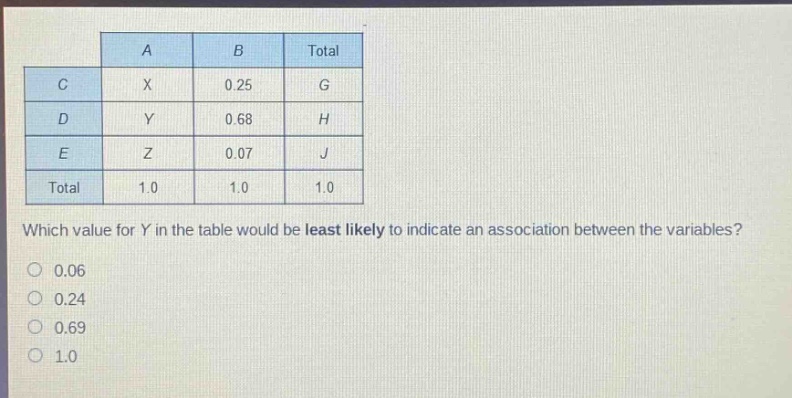
a b total c x 0.25 g d y 0.68 h e z 0.07 j total 1.0 1.0 1.0 which value for y in the table would be least likely to indicate an association between the variables? 0.06 0.24 0.69 1.0
Answer
Explanation:
Step1: Recall the concept of independence
If two - way table variables are independent, the row - column products should be proportional. When there is no association (i.e., independence), the relative frequencies in each row and column should be similar.
Step2: Analyze the given table
The total of column B is 1.0, with values 0.25, 0.68, and 0.07 for rows C, D, and E respectively. The total of column A is also 1.0. For independence, the ratio of values in column A for rows C, D, and E should be similar to the ratio of values in column B for those rows. The sum of the values in column B for rows C, D, and E is (0.25 + 0.68+0.07=1.0). If there is no association, the values in column A for rows C, D, and E should be in the same proportion as those in column B. The value of Y that would least likely indicate an association is the one that makes the distribution of A similar to the distribution of B across the rows. The distribution of B has a large value (0.68) in row D. To have no association, the value of Y should be close to 0.68 so that the relative frequencies of the two variables are similar across the rows.
Answer:
0.69