traffic speed: the mean speed for a sample of 42 cars at a certain intersection was 28.48 kilometers per…
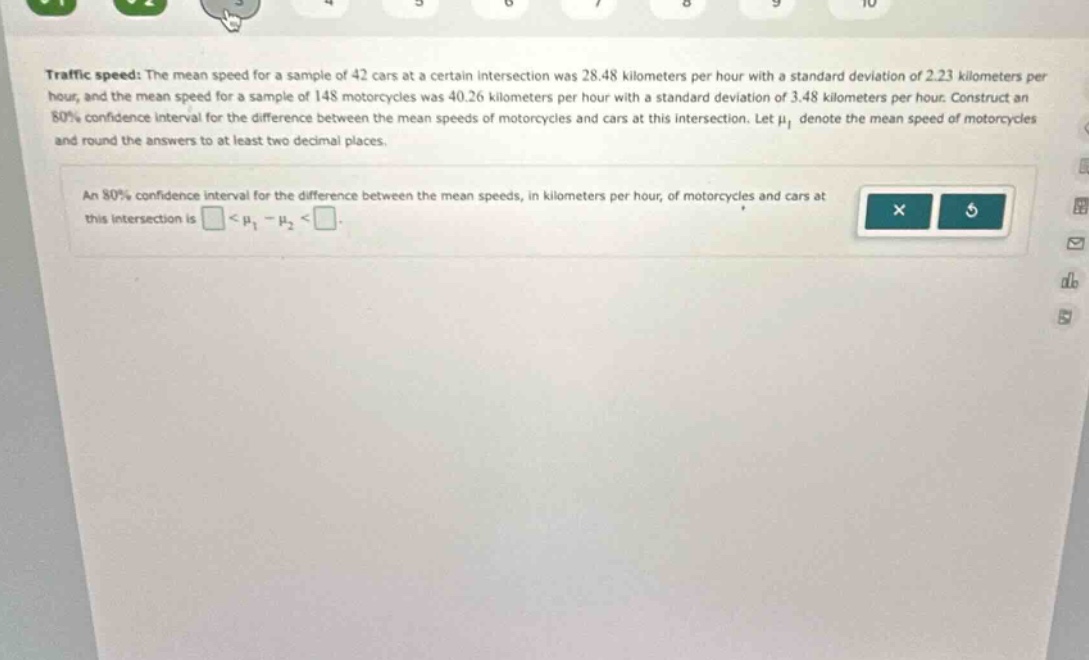
traffic speed: the mean speed for a sample of 42 cars at a certain intersection was 28.48 kilometers per hour with a standard deviation of 2.23 kilometers per hour, and the mean speed for a sample of 148 motorcycles was 40.26 kilometers per hour with a standard deviation of 3.48 kilometers per hour. construct an 80% confidence interval for the difference between the mean speeds of motorcycles and cars at this intersection. let $mu_1$ denote the mean speed of motorcycles and round the answers to at least two decimal places.\nan 80% confidence interval for the difference between the mean speeds, in kilometers per hour, of motorcycles and cars at this intersection is $square<mu_1 - mu_2<square$.
Answer
Explanation:
Step1: Identify the given values
Let $n_1 = 148$ (sample - size of motorcycles), $\bar{x}_1=40.26$ (mean speed of motorcycles), $s_1 = 3.48$ (standard - deviation of motorcycles), $n_2 = 42$ (sample - size of cars), $\bar{x}_2=28.48$ (mean speed of cars), $s_2 = 2.23$ (standard - deviation of cars). The confidence level is $80%$, so $\alpha=1 - 0.80=0.20$ and $\alpha/2=0.10$.
Step2: Find the critical value
The degrees of freedom is calculated using the formula $df=\min(n_1 - 1,n_2 - 1)=\min(148 - 1,42 - 1)=41$. Looking up in the $t$ - distribution table or using a calculator, the critical value $t_{\alpha/2,df}=t_{0.10,41}\approx1.303$.
Step3: Calculate the standard error
The standard error formula for the difference between two means is $SE=\sqrt{\frac{s_1^{2}}{n_1}+\frac{s_2^{2}}{n_2}}$. [ \begin{align*} SE&=\sqrt{\frac{3.48^{2}}{148}+\frac{2.23^{2}}{42}}\ &=\sqrt{\frac{12.1104}{148}+\frac{4.9729}{42}}\ &=\sqrt{0.081827 + 0.118402}\ &=\sqrt{0.199929}\ &\approx0.447 \end{align*} ]
Step4: Calculate the margin of error
The margin of error $E = t_{\alpha/2}\times SE$. So $E=1.303\times0.447\approx0.583$.
Step5: Calculate the confidence interval
The confidence interval for $\mu_1-\mu_2$ is $(\bar{x}_1-\bar{x}_2)-E<\mu_1 - \mu_2<(\bar{x}_1-\bar{x}_2)+E$. [ \begin{align*} \bar{x}_1-\bar{x}_2&=40.26 - 28.48=11.78\ (\bar{x}_1-\bar{x}_2)-E&=11.78-0.583 = 11.197\approx11.20\ (\bar{x}_1-\bar{x}_2)+E&=11.78 + 0.583=12.363\approx12.36 \end{align*} ]
Answer:
$11.20<\mu_1-\mu_2<12.36$