of the trains that recently arrived at winchester station, 279 were on time and 135 were late. what is the…
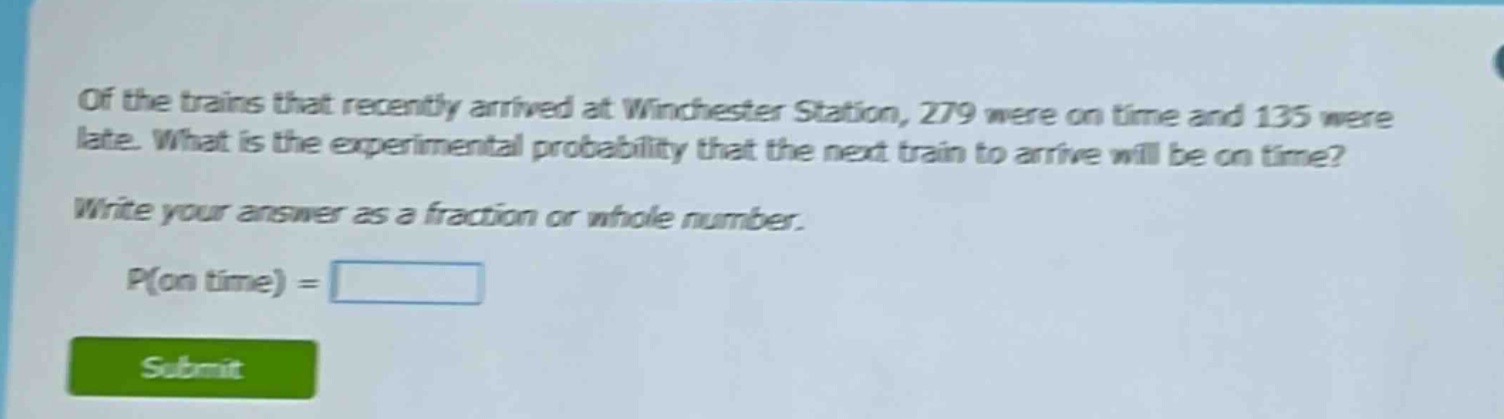
of the trains that recently arrived at winchester station, 279 were on time and 135 were late. what is the experimental probability that the next train to arrive will be on time? write your answer as a fraction or whole number. p(on time) =
Answer
Explanation:
Step1: Find total number of trains
The total number of trains is the sum of on - time and late trains. So, $279 + 135=414$.
Step2: Calculate experimental probability
The experimental probability $P(\text{on time})$ of the next train being on time is the number of on - time trains divided by the total number of trains. So, $P(\text{on time})=\frac{279}{414}$. Simplifying the fraction $\frac{279}{414}=\frac{31}{46}$ (dividing both numerator and denominator by 9).
Answer:
$\frac{31}{46}$