trisha has 2 boxes of marbles. she selects a marble from each box 100 times, replacing the marble back into…
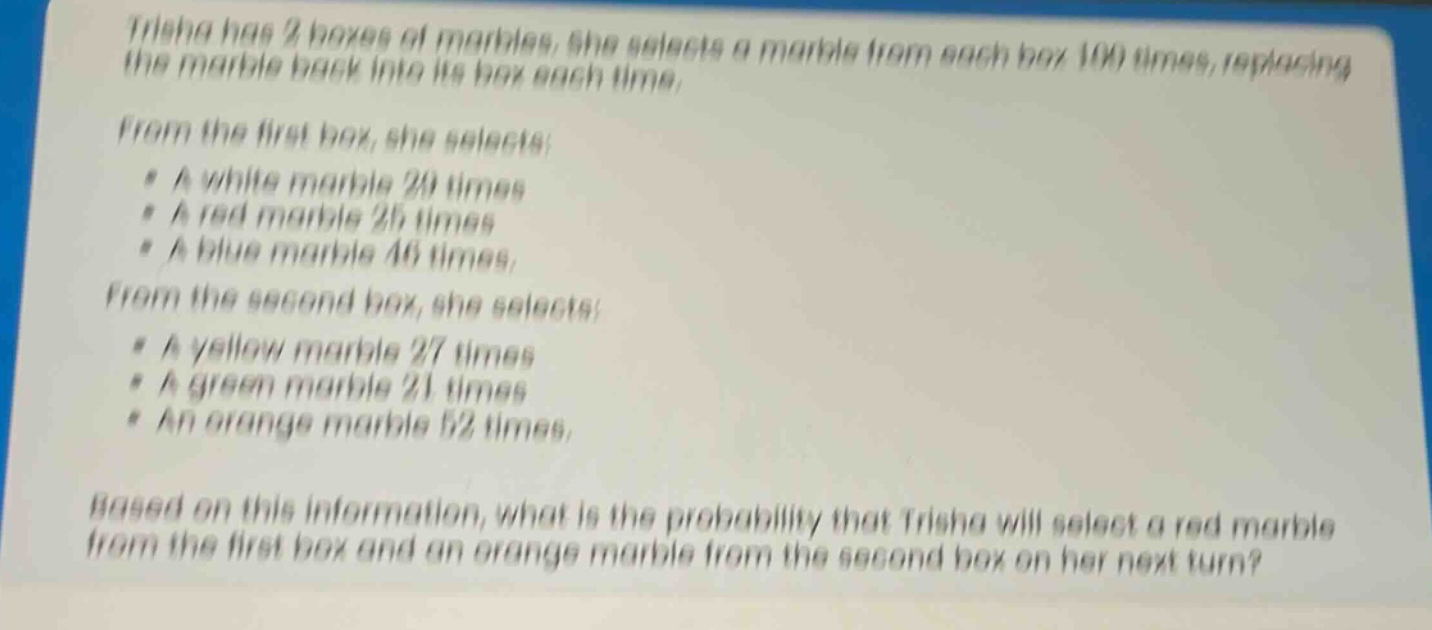
trisha has 2 boxes of marbles. she selects a marble from each box 100 times, replacing the marble back into its box each time. from the first box, she selects: a white marble 29 times a red marble 25 times a blue marble 46 times. from the second box, she selects: a yellow marble 27 times a green marble 21 times an orange marble 52 times. based on this information, what is the probability that trisha will select a red marble from the first box and an orange marble from the second box on her next turn?
Answer
Explanation:
Step1: Calculate probability of red from first box
The probability of an event is the number of favorable outcomes divided by the total number of outcomes. For the first - box, the total number of selections is 100, and the number of times a red marble is selected is 25. So the probability of selecting a red marble from the first box, $P(R)=\frac{25}{100}=\frac{1}{4}$.
Step2: Calculate probability of orange from second box
For the second - box, the total number of selections is 100, and the number of times an orange marble is selected is 52. So the probability of selecting an orange marble from the second box, $P(O)=\frac{52}{100}=\frac{13}{25}$.
Step3: Use the multiplication rule for independent events
Since the selections from the two boxes are independent events, the probability of both events occurring is the product of their individual probabilities. So $P(R\cap O)=P(R)\times P(O)$. Substitute the values: $P(R\cap O)=\frac{1}{4}\times\frac{13}{25}=\frac{13}{100}=0.13$.
Answer:
$0.13$