what is true about the variability of the prices of socks in kid sizes or adult sizes?\nthere is more…
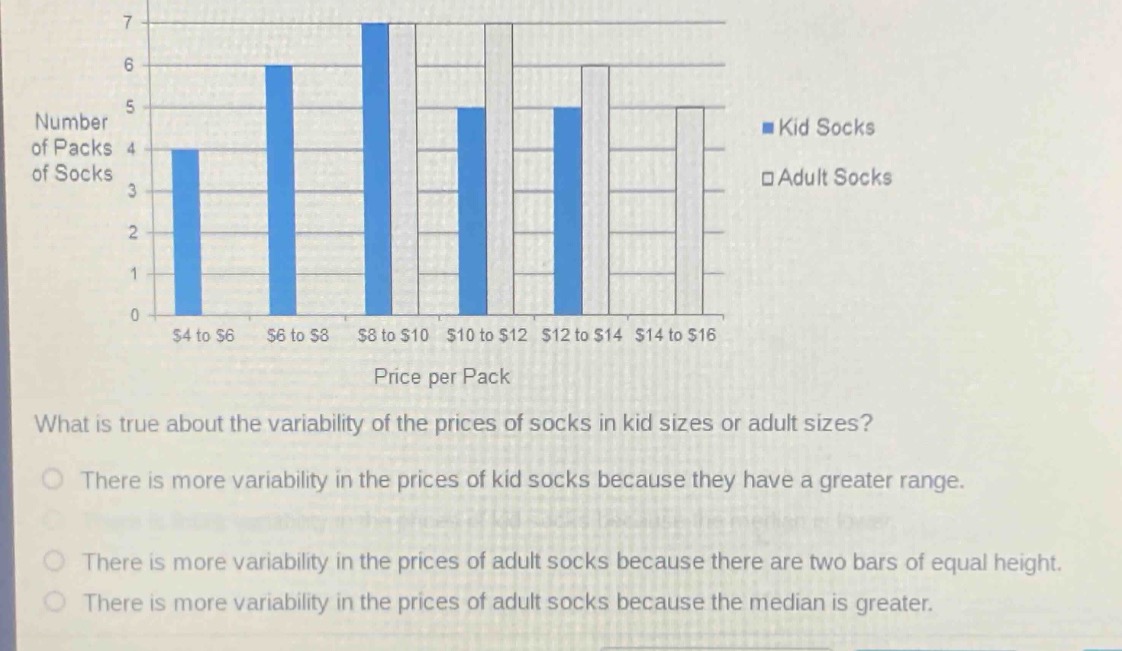
what is true about the variability of the prices of socks in kid sizes or adult sizes?\nthere is more variability in the prices of kid socks because they have a greater range.\nthere is more variability in the prices of adult socks because there are two bars of equal height.\nthere is more variability in the prices of adult socks because the median is greater.
Answer
Explanation:
Step1: Calculate range for kid - socks
Range = Max price - Min price. For kid - socks, min price is $4$ and max price is $14$, so range = $14 - 4=10$.
Step2: Calculate range for adult - socks
For adult - socks, min price is $6$ and max price is $16$, so range = $16 - 6 = 10$.
Step3: Analyze variability
Variability can be measured by range. Since the range of kid - socks ($10$) is equal to the range of adult - socks ($10$), we need to consider other factors. But looking at the options, the first option says there is more variability in kid - socks because of a greater range which is incorrect as ranges are equal. The second option about two bars of equal height has no relation to variability. The third option about median is not relevant as median is a measure of central tendency not variability. However, if we consider the spread conceptually, we note that the range is a measure of spread. And since the range of kid - socks is $10$ and for adult - socks is also $10$, we can say that the statement "There is more variability in the prices of kid socks because they have a greater range" is false.
Answer:
There is more variability in the prices of kid socks because they have a greater range. (This option is incorrect as ranges are equal, but it is the only one we can analyze based on the given options and the concept of range for variability)