two distinct number cubes, one red and one blue, are rolled together. each number cube has sides numbered 1…
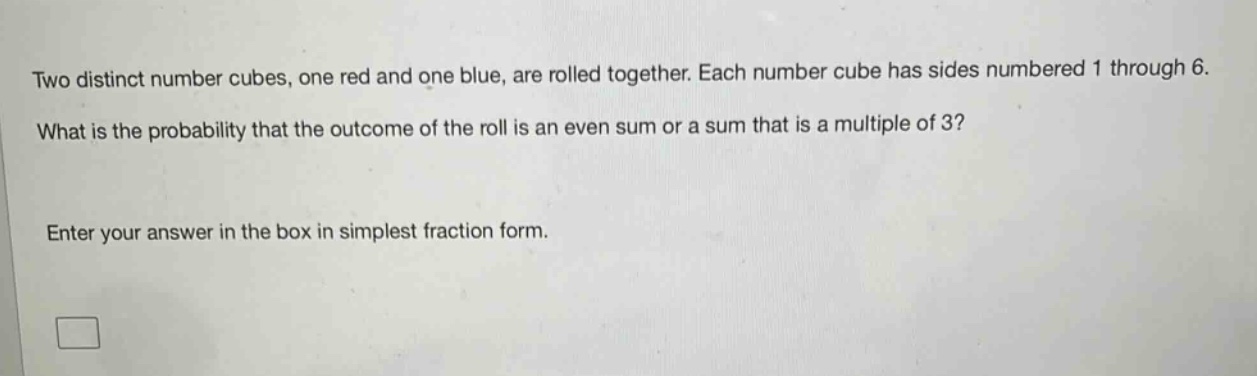
two distinct number cubes, one red and one blue, are rolled together. each number cube has sides numbered 1 through 6. what is the probability that the outcome of the roll is an even sum or a sum that is a multiple of 3? enter your answer in the box in simplest fraction form.
Answer
Explanation:
Step1: Calculate total number of outcomes
When rolling two number - cubes, each with 6 sides, the total number of outcomes is (n(S)=6\times6 = 36) since for each outcome of the red cube (6 possibilities), there are 6 possibilities for the blue cube.
Step2: List all possible sums and their frequencies
Let the outcome of the red cube be (x) and the outcome of the blue cube be (y). The sum (s=x + y). The possible sums range from (1 + 1=2) to (6+6 = 12). The sums and their combinations:
- (s = 2): ((1,1)) (1 combination)
- (s=3): ((1,2),(2,1)) (2 combinations)
- (s = 4): ((1,3),(2,2),(3,1)) (3 combinations)
- (s=5): ((1,4),(2,3),(3,2),(4,1)) (4 combinations)
- (s = 6): ((1,5),(2,4),(3,3),(4,2),(5,1)) (5 combinations)
- (s=7): ((1,6),(2,5),(3,4),(4,3),(5,2),(6,1)) (6 combinations)
- (s = 8): ((2,6),(3,5),(4,4),(5,3),(6,2)) (5 combinations)
- (s=9): ((3,6),(4,5),(5,4),(6,3)) (4 combinations)
- (s = 10): ((4,6),(5,5),(6,4)) (3 combinations)
- (s=11): ((5,6),(6,5)) (2 combinations)
- (s = 12): ((6,6)) (1 combination)
Step3: Determine the number of sums that are even
The sum (s=x + y) is even if either both (x) and (y) are even or both (x) and (y) are odd. The number of combinations where both are odd: (3\times3 = 9) (odd numbers on red cube are 1, 3, 5 and on blue cube are 1, 3, 5). The number of combinations where both are even: (3\times3=9). So, (n(A)=9 + 9=18).
Step4: Determine the number of sums that are multiples of 3
The sums that are multiples of 3 are (s = 3,6,9,12). The number of combinations for (s = 3) is 2, for (s = 6) is 5, for (s = 9) is 4, and for (s = 12) is 1. So, (n(B)=2 + 5+4 + 1=12).
Step5: Determine the number of sums that are both even and multiples of 3
The sums that are both even and multiples of 3 are (s = 6,12). The number of combinations for (s = 6) is 5 and for (s = 12) is 1. So, (n(A\cap B)=5 + 1=6).
Step6: Use the inclusion - exclusion principle
The formula for (P(A\cup B)) is (P(A\cup B)=\frac{n(A)+n(B)-n(A\cap B)}{n(S)}). Substitute (n(A) = 18), (n(B)=12), (n(A\cap B)=6) and (n(S)=36) into the formula: [P(A\cup B)=\frac{18 + 12-6}{36}=\frac{24}{36}=\frac{2}{3}]
Answer:
(\frac{2}{3})