which two events are independent? a 15 5 10 30 b 5 8 7 20 c 30 15 5 50 total 50 28 22 100 o a and x o a and…
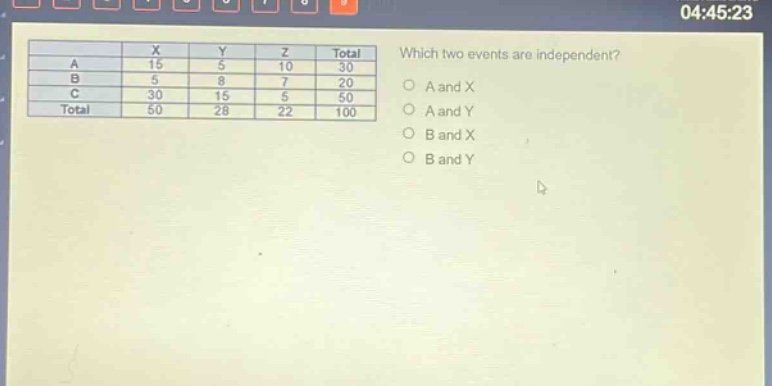
which two events are independent? a 15 5 10 30 b 5 8 7 20 c 30 15 5 50 total 50 28 22 100 o a and x o a and y o b and x o b and y
Answer
Answer:
A. A and X
Explanation:
Step1: Recall independence formula
Two events (E) and (F) are independent if (P(E\cap F)=P(E)\times P(F)). In terms of a contingency - table, if (n(E\cap F)) is the number of elements in the intersection of (E) and (F), (n(E)) is the number of elements in (E), (n(F)) is the number of elements in (F), and (N) is the total number of elements, then (n(E\cap F)=\frac{n(E)\times n(F)}{N}).
Step2: Calculate for A and X
For events (A) and (X): (n(A) = 30), (n(X)=50), (N = 100), and (n(A\cap X)=15). Then (\frac{n(A)\times n(X)}{N}=\frac{30\times50}{100}=15), which is equal to (n(A\cap X)).
Step3: Calculate for A and Y
For events (A) and (Y): (n(A) = 30), (n(Y)=28), (N = 100), and (n(A\cap Y)=5). Then (\frac{n(A)\times n(Y)}{N}=\frac{30\times28}{100}=8.4\neq5).
Step4: Calculate for B and X
For events (B) and (X): (n(B) = 20), (n(X)=50), (N = 100), and (n(B\cap X)=5). Then (\frac{n(B)\times n(X)}{N}=\frac{20\times50}{100}=10\neq5).
Step5: Calculate for B and Y
For events (B) and (Y): (n(B) = 20), (n(Y)=28), (N = 100), and (n(B\cap Y)=8). Then (\frac{n(B)\times n(Y)}{N}=\frac{20\times28}{100}=5.6\neq8).