two groups of students hypothesized that rocks on earths surface are damaged by acid rain.\ngroup x tested…
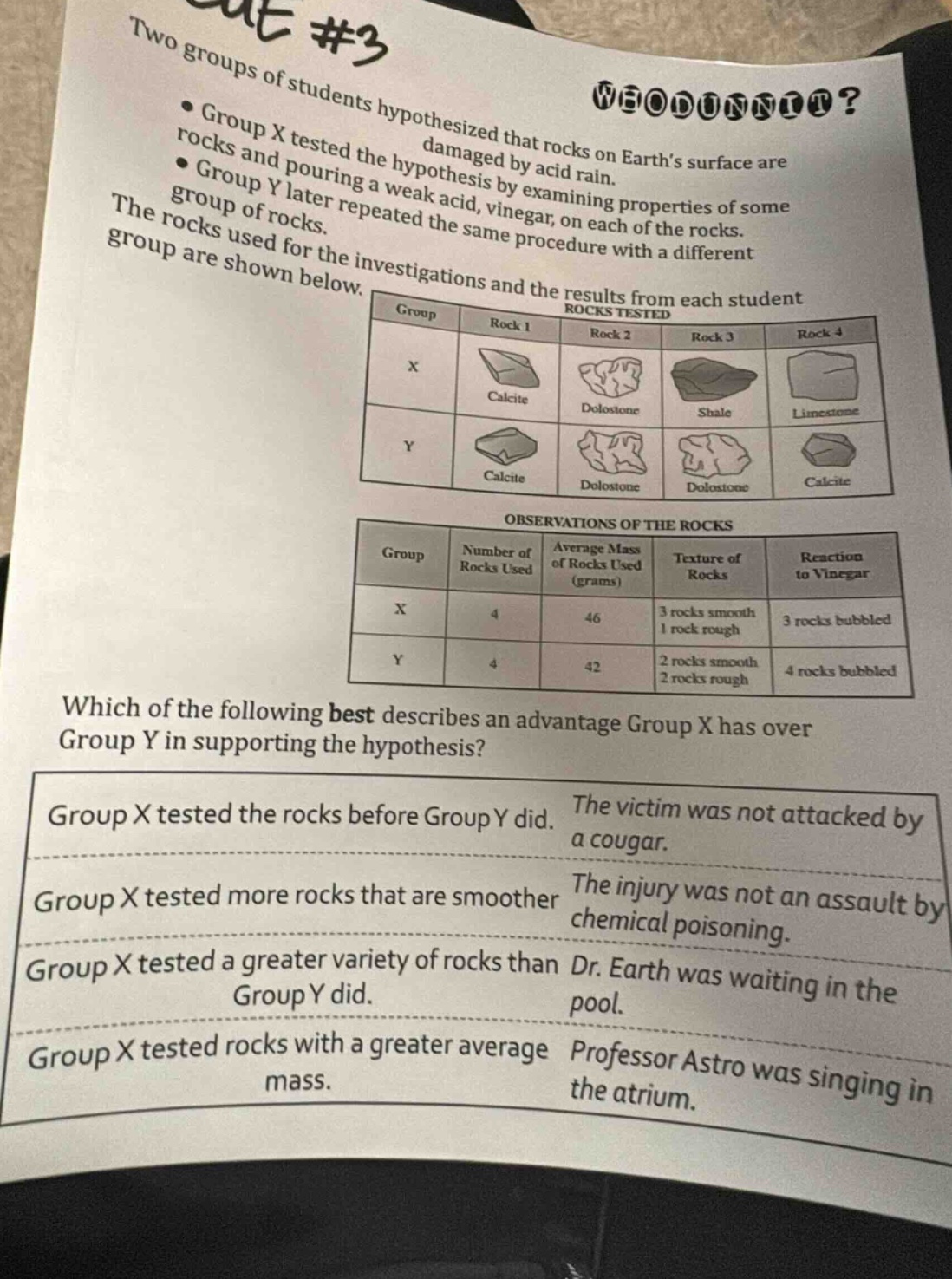
two groups of students hypothesized that rocks on earths surface are damaged by acid rain.\ngroup x tested the hypothesis by examining properties of some rocks and pouring a weak acid, vinegar, on each of the rocks.\ngroup y later repeated the same procedure with a different group of rocks.\nthe rocks used for the investigations and the results from each student group are shown below.\nrocks tested\n|group|rock 1|rock 2|rock 3|rock 4|\n|----|----|----|----|----|\n|x|calcite|dolostone|shale|limestone|\n|y|calcite|dolostone|dolostone|calcite|\nobservations of the rocks\n|group|number of rocks used|average mass of rocks used (grams)|texture of rocks|reaction to vinegar|\n|----|----|----|----|----|\n|x|4|46|3 rocks smooth 1 rock rough|3 rocks bubbled|\n|y|4|42|2 rocks smooth 2 rocks rough|4 rocks bubbled|\nwhich of the following best describes an advantage group x has over group y in supporting the hypothesis?\ngroup x tested the rocks before group y did. the victim was not attacked by a cougar.\ngroup x tested more rocks that are smoother the injury was not an assault by chemical poisoning.\ngroup x tested a greater variety of rocks than dr. earth was waiting in the pool.\ngroup x tested rocks with a greater average mass. professor astro was singing in the atrium.
Answer
Brief Explanations:
A greater variety of rocks in testing can provide more comprehensive evidence for the hypothesis about rock - damage by acid rain. Group X tested Calcite, Dolostone, Shale, and Limestone, while Group Y tested mainly Calcite and Dolostone. Testing time is not relevant to supporting the hypothesis. Texture and average mass of rocks do not directly contribute to better support of the hypothesis compared to variety.
Answer:
Group X tested a greater variety of rocks than Group Y did.