two methods to screen women for possible breast cancer are available. a random sample of 20 women known to…
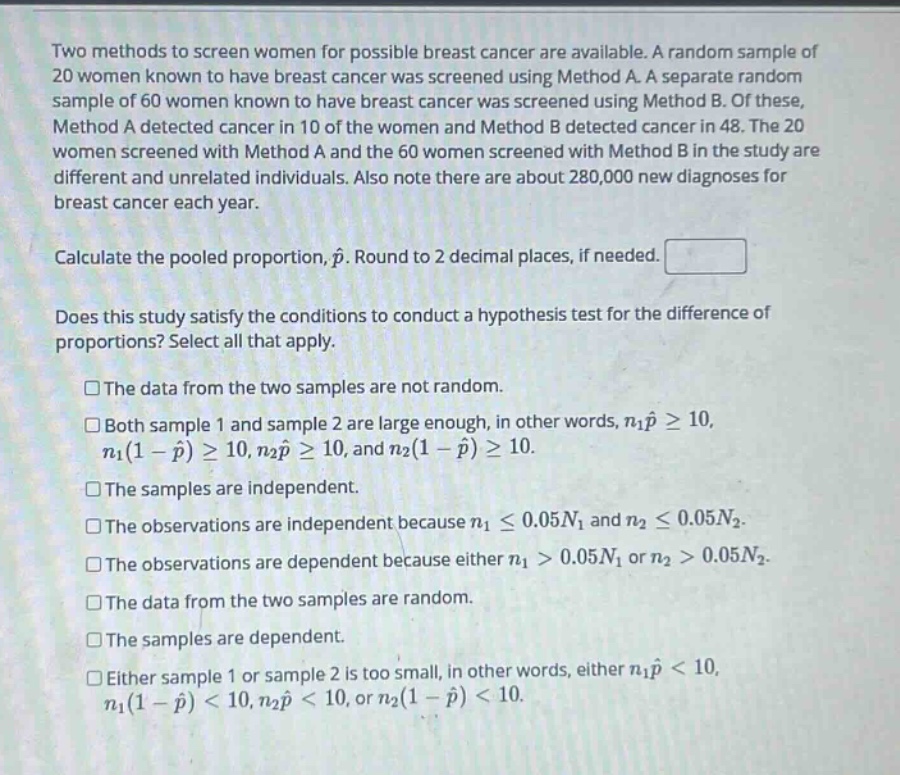
two methods to screen women for possible breast cancer are available. a random sample of 20 women known to have breast cancer was screened using method a. a separate random sample of 60 women known to have breast cancer was screened using method b. of these, method a detected cancer in 10 of the women and method b detected cancer in 48. the 20 women screened with method a and the 60 women screened with method b in the study are different and unrelated individuals. also note there are about 280,000 new diagnoses for breast cancer each year.\n\ncalculate the pooled proportion, $hat{p}$. round to 2 decimal places, if needed.\n\ndoes this study satisfy the conditions to conduct a hypothesis test for the difference of proportions? select all that apply.\n\n□the data from the two samples are not random.\n\n□both sample 1 and sample 2 are large enough, in other words, $n_1hat{p}geq10$, $n_1(1 - hat{p})geq10$, $n_2hat{p}geq10$, and $n_2(1 - hat{p})geq10$.\n\n□the samples are independent.\n\n□the observations are independent because $n_1leq0.05n_1$ and $n_2leq0.05n_2$.\n\n□the observations are dependent because either $n_1 > 0.05n_1$ or $n_2 > 0.05n_2$.\n\n□the data from the two samples are random.\n\n□the samples are dependent.\n\n□either sample 1 or sample 2 is too small, in other words, either $n_1hat{p}<10$, $n_1(1 - hat{p})<10$, $n_2hat{p}<10$, or $n_2(1 - hat{p})<10$.
Answer
Explanation:
Step1: Identify sample - related values
Let $n_1 = 20$ (sample size of Method A), $x_1 = 10$ (number of detections in Method A), $n_2=60$ (sample size of Method B), $x_2 = 48$ (number of detections in Method B).
Step2: Calculate the pooled proportion formula
The formula for the pooled proportion $\hat{p}=\frac{x_1 + x_2}{n_1 + n_2}$. Substitute the values: $\hat{p}=\frac{10 + 48}{20+60}=\frac{58}{80}=0.725\approx0.73$.
For the conditions of hypothesis - test for the difference of proportions:
- The data from the two samples are random since it is stated that "A random sample of 20 women... A separate random sample of 60 women".
- Calculate $n_1\hat{p}=20\times0.73 = 14.6\geq10$, $n_1(1 - \hat{p})=20\times(1 - 0.73)=20\times0.27 = 5.4<10$, $n_2\hat{p}=60\times0.73 = 43.8\geq10$, $n_2(1 - \hat{p})=60\times(1 - 0.73)=60\times0.27 = 16.2\geq10$. So, the samples are not both large enough.
- The samples are independent as "The 20 women screened with Method A and the 60 women screened with Method B in the study are different and unrelated individuals".
- Let $N$ be the total number of new breast - cancer diagnoses per year ($N = 280000$). $n_1=20$, $n_2 = 60$, $0.05N=0.05\times280000 = 14000$. Since $n_1=20\leq0.05N$ and $n_2 = 60\leq0.05N$, the observations are independent.
Answer:
The pooled proportion $\hat{p}\approx0.73$. The conditions that apply are:
- The samples are independent.
- The data from the two samples are random.
- The observations are independent because $n_1\leq0.05N_1$ and $n_2\leq0.05N_2$.