two percent of mobile phones produced at a factory are defective. which of the following is a binomial…
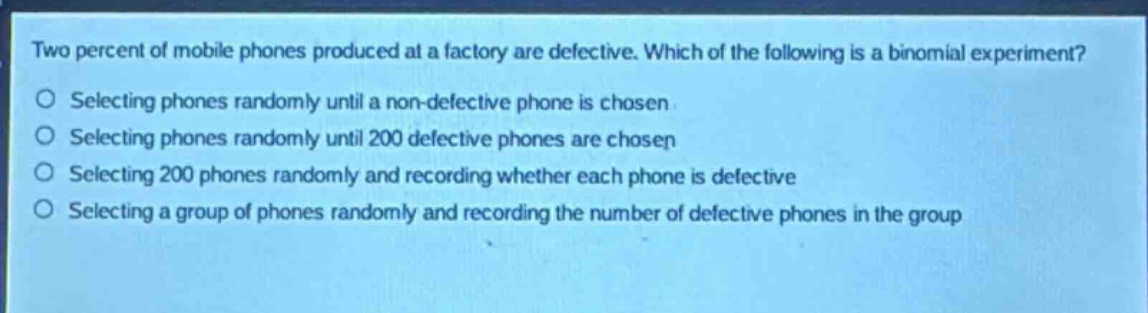
two percent of mobile phones produced at a factory are defective. which of the following is a binomial experiment?\nselecting phones randomly until a non - defective phone is chosen\nselecting phones randomly until 200 defective phones are chosen\nselecting 200 phones randomly and recording whether each phone is defective\nselecting a group of phones randomly and recording the number of defective phones in the group
Answer
Brief Explanations:
A binomial experiment has the following characteristics: a fixed number of trials ((n)), each trial has only two possible outcomes (success - defective phone, failure - non - defective phone), the probability of success ((p = 0.02)) is constant for each trial, and the trials are independent.
- For “Selecting phones randomly until a non - defective phone is chosen”: The number of trials is not fixed. It could be 1, 2, 3, etc. So, it is not a binomial experiment.
- For “Selecting phones randomly until 200 defective phones are chosen”: The number of trials is not fixed. We don't know in advance how many phones we need to select to get 200 defective ones. So, it is not a binomial experiment.
- For “Selecting 200 phones randomly and recording whether each phone is defective”: Here, (n = 200) (fixed number of trials), each trial (checking a phone) has two outcomes (defective or not defective), the probability of a phone being defective ((p=0.02)) is constant for each trial, and the trials (checking each phone) are independent. So, it is a binomial experiment.
- For “Selecting a group of phones randomly and recording the number of defective phones in the group”: The number of trials ((n)) is not specified as a fixed number. So, it is not a binomial experiment.
Answer:
Selecting 200 phones randomly and recording whether each phone is defective.