for two programs at a university, the type of student for two majors is as follows.\n| | history | science |…
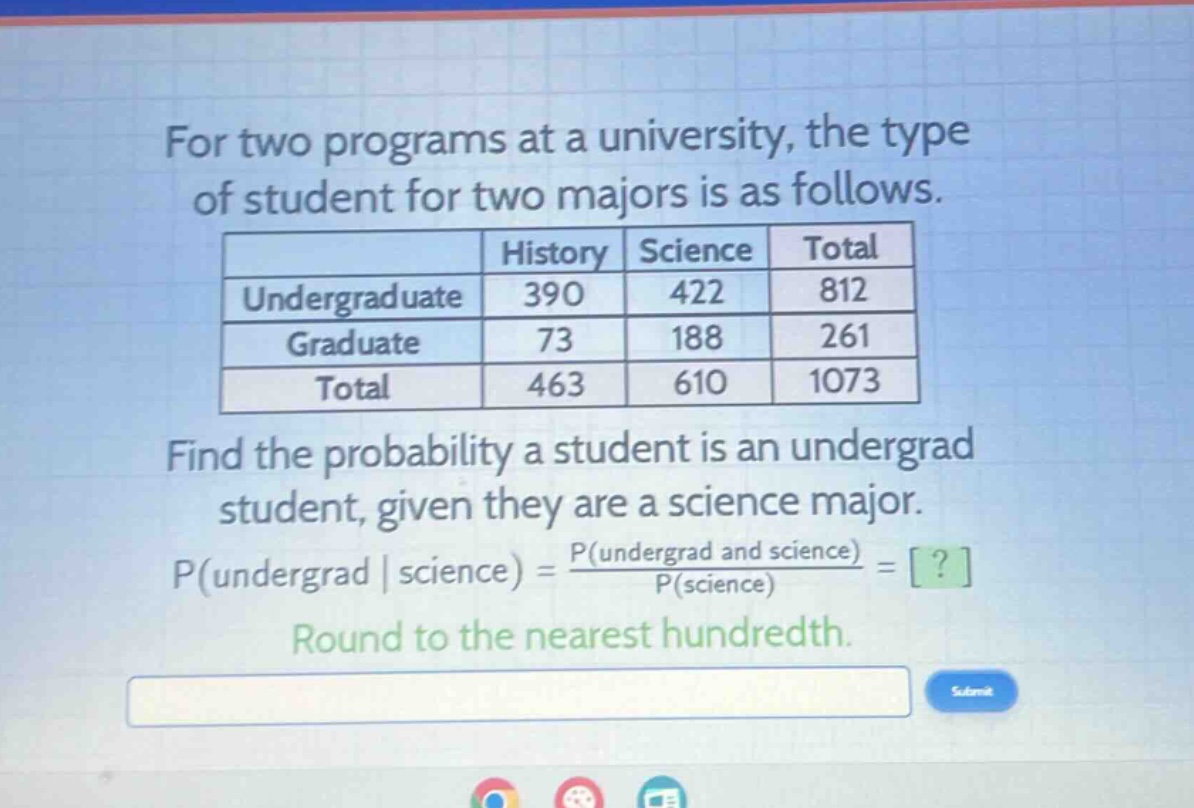
for two programs at a university, the type of student for two majors is as follows.\n| | history | science | total |\n|--|--|--|--|\n| undergraduate | 390 | 422 | 812 |\n| graduate | 73 | 188 | 261 |\n| total | 463 | 610 | 1073 |\nfind the probability a student is an undergrad student, given they are a science major.\np(undergrad | science) = \\frac{p(undergrad and science)}{p(science)} = ?\nround to the nearest hundredth.
Answer
Explanation:
Step1: Identify values from table
The number of undergraduate - science students is 422, and the total number of science students is 610.
Step2: Calculate the conditional probability
The formula for conditional probability is $P(A|B)=\frac{P(A\cap B)}{P(B)}$. Here, $A$ is the event of being an undergraduate student and $B$ is the event of being a science - major student. So $P(\text{undergrad}|\text{science})=\frac{\text{Number of undergrad and science students}}{\text{Total number of science students}}=\frac{422}{610}$.
Step3: Simplify the fraction
$\frac{422}{610}\approx0.69$
Answer:
$0.69$